
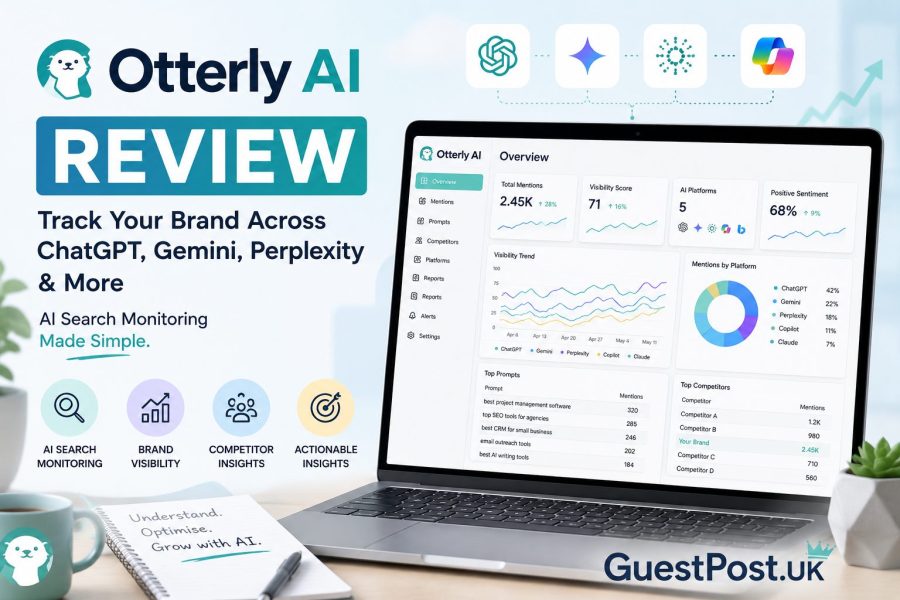
Otterly AI Review: Tracking Your Brand Across ChatGPT, Gemini and Perplexity
Imagine spending thousands on SEO, publishing dozens of articles, earning quality backlinks, and building a recognised brand within your industry.
Then a potential customer opens ChatGPT and asks:
“What’s the best project management software?”
Your competitor appears.
You don’t.
No ranking report warns you about it. No backlink audit reveals it. No traditional SEO tool tells you it happened.
That’s the problem a growing number of marketers are facing, and it’s exactly where Otterly AI enters the conversation.
While many SEO platforms are still focused on Google’s ten blue links, Otterly AI is focused on a newer battlefield: AI-generated recommendations.
Why Otterly AI Exists
Traditional SEO tools were built for search engines.
Otterly AI was built for answer engines.
The difference matters.
When users search Google, they often click multiple results before making a decision.
When users ask ChatGPT, Perplexity, Gemini, or Copilot a question, they frequently receive a complete answer immediately.
In many cases, the decision-making process occurs before a website visit even takes place.
This creates a new challenge for brands:
Are AI systems talking about your company when buyers ask questions?
Otterly AI attempts to provide an answer.
My First Impression of Otterly AI
Most GEO platforms overwhelm users with dashboards filled with unfamiliar metrics.
Otterly AI takes a different approach.
The platform focuses on one simple objective:
Track where your brand appears inside AI-generated answers.
That simplicity is one of its biggest strengths.
Instead of drowning users in data, the platform concentrates on visibility, mentions, prompts, and trends.
For businesses entering GEO for the first time, this approach feels more accessible than many enterprise-focused alternatives.
The Core Problem Otterly AI Solves
Consider this example.
A cybersecurity training company ranks first for several important keywords.
Leads are arriving.
Everything appears positive.
However, users increasingly ask AI assistants:
- Best cybersecurity certification providers
- Best online security courses
- Top cybersecurity training companies
If AI systems repeatedly recommend competitors, traditional SEO success becomes less meaningful over time.
Otterly AI allows businesses to monitor those conversations.
How Otterly AI Tracks AI Visibility
The platform continuously checks AI-generated responses across supported AI ecosystems.
Its goal is to identify:
- Whether your brand appears
- How often do competitors appear
- Which prompts trigger mentions
- Changes in visibility over time
This makes AI search visibility measurable.
For years, marketers have measured rankings.
Now they can begin measuring recommendations.
Where Otterly AI Stands Out
Prompt-Level Monitoring
One of the more useful capabilities is prompt tracking.
Instead of simply reporting visibility scores, Otterly AI shows which questions generate brand mentions.
Examples include:
- Best SEO software
- Best CRM platform
- Best email outreach tool
This allows marketers to identify exactly where opportunities exist.
Competitor Discovery
Many businesses think they know their competitors.
AI platforms sometimes reveal a different picture.
Otterly AI frequently uncovers brands receiving AI recommendations that may not even appear in traditional search competitor reports.
This can be particularly valuable for SaaS companies.
Historical Visibility Trends
Visibility snapshots are useful.
Visibility trends are more valuable.
Otterly AI enables marketers to observe whether AI presence is improving, declining, or remaining stagnant over time.
This creates a framework for measuring GEO campaigns.
A Practical Example
Let’s imagine an outreach software company launches:
- 20 new blog articles
- Several industry studies
- A digital PR campaign
- New comparison pages
Three months later, traditional metrics improve.
Traffic rises.
Backlinks increase.
Rankings improve.
The remaining question becomes:
“Did AI systems start mentioning the brand more often?”
Otterly AI helps answer that question.
Where Otterly AI Fits Within a Modern Marketing Stack
Many people ask whether GEO tools will replace SEO platforms.
The answer is no.
Think of the relationship like this:
Traditional SEO tools tell you whether search engines trust your website.
GEO tools tell you whether AI systems recommend your brand.
Both measurements are becoming important.
A modern stack may look like:
- Ahrefs for backlink intelligence
- Semrush for keyword research
- Google Search Console for performance monitoring
- Otterly AI for AI visibility tracking
Each serves a different purpose.
Strengths That Make Otterly AI Interesting
Easy to Understand
Many GEO tools are still targeting enterprise users.
Otterly AI feels accessible to smaller teams.
Strong GEO Focus
The platform remains focused on AI visibility rather than becoming an all-in-one SEO suite.
Useful for Agencies
Agencies can demonstrate GEO progress through measurable reporting.
Growing Category Potential
As AI search grows, demand for GEO measurement tools is likely to increase.
Areas Where Otterly AI Still Faces Challenges
The GEO market remains young.
As a result, some limitations affect almost every platform in the sector.
AI Search Is Still Evolving
ChatGPT, Gemini, Perplexity and Copilot frequently change how responses are generated.
Tracking systems must continually adapt.
No Technical SEO Capabilities
Users still require separate platforms for:
- Site audits
- Backlink analysis
- Rank tracking
- Keyword research
Limited Historical Industry Benchmarks
Because GEO is relatively new, industry benchmarks are still developing.
Otterly AI vs Profound
Profound often targets larger organisations.
Otterly AI feels more approachable for smaller teams.
If you’re an enterprise brand needing executive reporting and stakeholder dashboards, Profound may be the stronger choice.
If you’re looking for a straightforward GEO monitoring platform without enterprise complexity, Otterly AI becomes very attractive.
Otterly AI vs Peec AI
Peec AI tends to place greater emphasis on citation analysis.
Otterly AI places more emphasis on visibility tracking and prompt monitoring.
Both tools address similar challenges, but their priorities differ slightly.
Businesses focused on content strategy may lean towards Peec AI.
Businesses focused on monitoring AI recommendations may prefer Otterly AI.
The GEO Trend Every Marketer Should Watch
Search behaviour is gradually shifting.
A simplified illustration:
2018
Google Search ███████████████████████
AI Search █
2022
Google Search ███████████████████
AI Search ███
2026
Google Search ██████████████
AI Search ██████████
The change isn’t happening overnight.
However, enough evidence now exists to justify monitoring AI visibility alongside traditional SEO metrics.
Questions Marketers Ask About Otterly AI
Is Otterly AI replacing SEO?
No.
It complements SEO by measuring visibility inside AI-generated answers.
Can Otterly AI improve rankings?
Not directly.
Its purpose is measurement and visibility tracking rather than optimisation.
Who should consider Otterly AI?
- SEO agencies
- SaaS companies
- B2B brands
- Content marketing teams
- Digital PR specialists
Does AI visibility matter today?
For some industries, absolutely.
Particularly in SaaS, technology, marketing, finance, education, and professional services.
Final Verdict: Should You Use Otterly AI?
Otterly AI addresses a question that traditional SEO platforms cannot answer:
“When people ask AI systems about my industry, does my brand appear?”
For businesses exploring Generative Engine Optimisation, that information is becoming increasingly valuable.
The platform isn’t trying to replace Ahrefs, Semrush, or Google Search Console.
Instead, it fills a growing gap between traditional search visibility and AI-generated discovery.
If your organisation is beginning to take GEO seriously, Otterly AI is one of the more approachable platforms currently available and deserves consideration alongside Profound and Peec AI.