
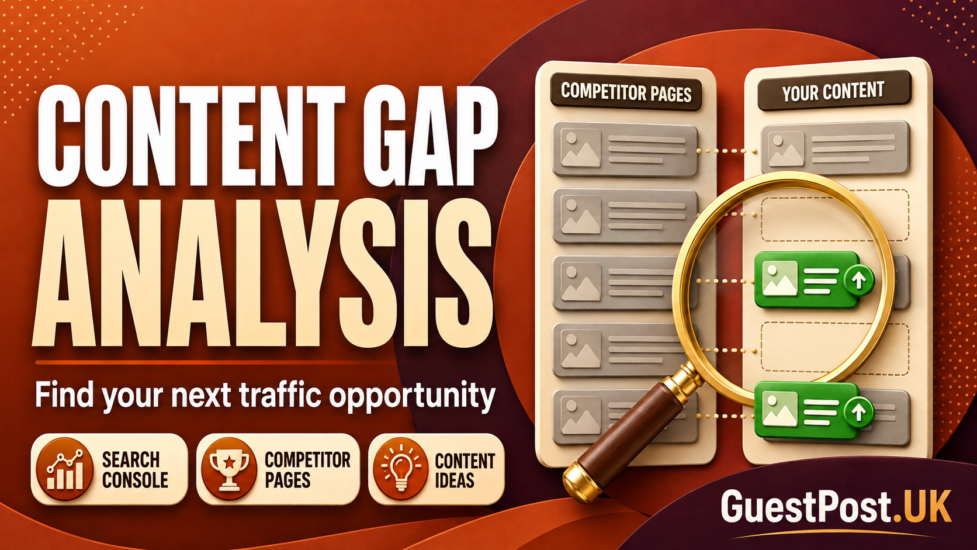
A content gap is not simply a keyword your competitor ranks for, and you do not. It is a useful question, subtopic, format or search intent that your audience needs help with—but your website does not answer well enough yet.
That is why content gap analysis can uncover much better opportunities than publishing whatever is popular in your niche. It shows where people are already finding your site, where they are not, and what your competitors may be doing more effectively.
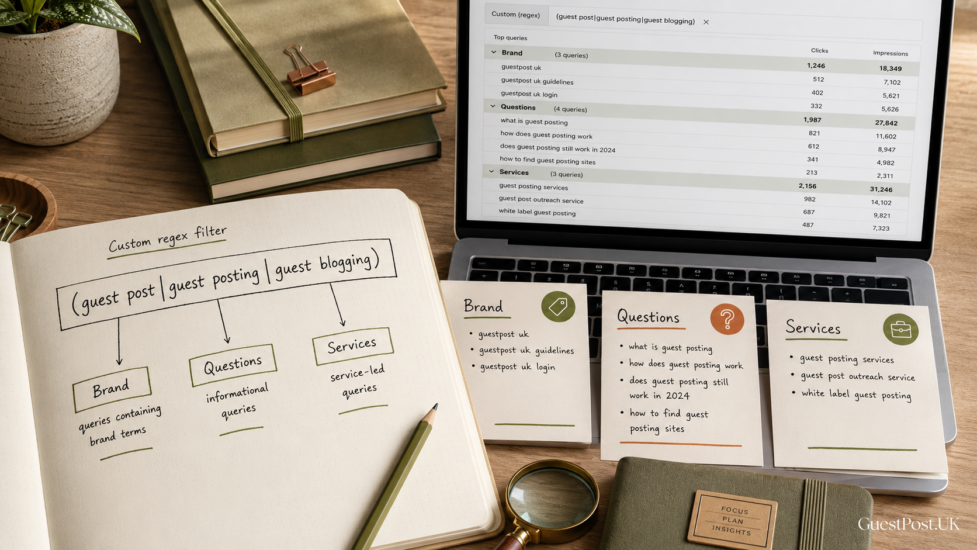
Google Search Console provides the starting evidence: the queries that generate impressions, the pages receiving clicks and the terms where you are visible but not winning. Combine that with a careful review of the current search results, and you can create content that serves a real purpose instead of adding another generic article to the blog.
A clear SEO content writing strategy should use this process before committing to a title or keyword.
Begin with pages that already have momentum
The easiest opportunities are often not completely new topics. They are existing pages that already receive impressions for relevant terms but do not yet fully satisfy the searcher.
In Google Search Console, open the Performance report and select a useful comparison period. Three to six months is usually enough to identify patterns without relying on a single short-term spike.
Then review:
- Pages with high impressions but low clicks
- Queries ranking around positions 8 to 20
- Articles that rank for many related terms but have weak CTR
- Commercial pages attracting broad informational searches
- Older posts whose impressions are rising but clicks are not
Google’s Performance report lets you examine clicks, impressions, CTR and average position by page and query. Use all four metrics together. A page with lots of impressions and a low CTR may need a stronger title or a closer match to intent. A page at position 14 may need meaningful content improvements, stronger internal linking, or a clearer answer to the query.
Look for the missing question behind the query
A query often reveals a need that your page only partly addresses.
For example, a guest posting guide may rank for:
- What is guest posting?
- Is guest posting safe for SEO?
- How much does guest posting cost?
- How to find niche-relevant guest posting sites
- Do guest post links need to be sponsored?
If the guide explains the first question well but provides no practical help with cost, relevance or link attributes, it has a content gap. The answer may be a new section, a supporting article or a separate service page—depending on the search intent.
Avoid adding every possible keyword to one page. The objective is to make the page more useful, not longer for its own sake.
A good question to ask is: “Would a reader feel their next logical question has been answered?” If not, you have identified a useful gap.
Review the pages already ranking
Do not copy competitors. Review what they cover to understand the current search intent and identify where you can contribute something better.
For a target query, examine the top-ranking pages and note:
| Element | What to look for |
|---|---|
| Intent | Is Google showing guides, service pages, tools, lists or product pages? |
| Common sections | Which practical questions appear on most strong pages? |
| Evidence | Do pages use first-hand examples, sources, data or screenshots? |
| Format | Is a comparison table, template, checklist or calculator expected? |
| Weaknesses | What is unclear, outdated, generic or missing? |
The goal is information gain. If every ranking page says the same thing, your article needs an original reason to exist: campaign experience, a clearer process, UK-specific detail, current data, a useful template or a more honest explanation of limitations.
Google’s guidance remains centred on helpful, reliable, people-first content. Content gap analysis should improve the reader’s outcome, not become a way to create thin pages around every long-tail variation.
Use Search Console to protect against bad ideas
Competitor tools can show thousands of phrases that another site ranks for. Many are irrelevant, low-value or incompatible with your business model.
Search Console gives you a useful filter: your own audience’s behaviour.
Before creating a new page, check whether similar queries already appear in your Performance report. If they do, you have evidence that Google already associates your site with the topic. That can make the opportunity more realistic than chasing a random competitor keyword.
For example, if your site receives impressions for “guest posting outreach template” but has no dedicated resource, a template article may be a strong fit. If a competitor ranks for “celebrity marketing jobs” and your site has no relevant audience or service, it is not a content gap—it is a distraction.
Decide whether to update, create or consolidate
Once you find an opportunity, choose the right action.
Update an existing page
Update when the page already addresses the core intent but lacks depth, clarity, evidence or current information. Add the missing section, examples, useful visuals and contextual internal links.
Create a supporting article
Create a new article when the query deserves a focused answer and would make an existing page too broad. A detailed guide on outreach templates can support a general guest posting guide without competing with it.
Strengthen a commercial page
If a service page attracts commercial searches but loses to competitors, improve the proof and decision-making information. Explain the process, pricing approach, quality checks, expected outcomes and who the service is for.
Consolidate overlap
If you already have two thin pages targeting the same intent, do not add a third. Merge or refocus the existing content first. This prevents unnecessary keyword cannibalisation and gives your strongest URL a clearer chance to perform.
Turn gaps into a realistic content plan
Not every gap deserves the same priority. Score each opportunity using four simple questions:
- Is the topic relevant to the audience and business?
- Is there evidence of search demand or existing impressions?
- Can you add something more useful than current ranking pages?
- Does the page support a meaningful next step?
A content topic that attracts traffic but has no relation to your expertise, services or wider site structure may not be worth the effort. A smaller, highly relevant topic can deliver more value if it naturally leads readers to a related guide or service.
Build your plan around clusters rather than disconnected posts. An article on linkable assets, for instance, can connect to outreach guidance, link reclamation, digital PR resources and your link building services. This helps visitors explore the topic while giving search engines clearer context.
Review the results and repeat
Content gaps change as competitors publish new material, search intent evolves, and your own site grows. Revisit the process quarterly for major topic clusters and monthly for high-priority pages.
Track whether the updated or new page gains impressions for the intended queries, then review clicks, CTR and conversions. If visibility grows but readers leave quickly, the page may still be missing the answer they expected.
The best content gap analysis is not a one-off competitor report. It is a habit of listening to search demand, studying what is already available and adding something your audience will genuinely value.