
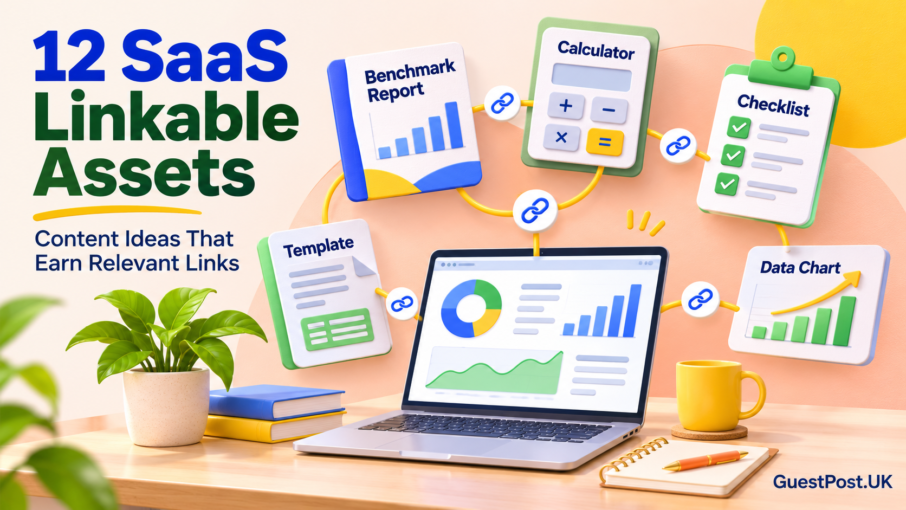
A SaaS company can publish dozens of blog posts without creating a single page that another website genuinely wants to reference.
The difference usually comes down to usefulness. A standard article may explain a topic well, but a strong linkable asset gives someone a reason to save it, share it with a colleague, use it in their work or cite it in their own content. It turns your expertise into something more practical than an opinion.
For SaaS brands, this does not mean building a huge free tool for every keyword. The best assets are often focused: a calculator that removes uncertainty, a benchmark that makes a decision easier, a template that saves time or a guide that answers a difficult implementation question properly.
What makes a SaaS linkable asset worth building?
A linkable asset should solve a genuine problem for a defined audience. It needs a clear purpose beyond “getting backlinks”.
Before investing time in one, ask:
- Would a prospect, customer, journalist or consultant find this useful without knowing your brand?
- Does it answer a question that cannot be fully solved with a short generic blog post?
- Can it be updated as your market, product category or data changes?
- Does it support a topic connected to your service, product or commercial audience?
The strongest assets often sit between education and utility. They help a reader make a decision, complete a task or understand an issue with more confidence.
For SaaS companies, this is especially valuable because the buying journey is rarely simple. Buyers compare tools, involve multiple stakeholders, look for proof and need to understand the cost of changing their current process.
1. Original industry benchmark reports
A benchmark report is one of the most effective linkable assets a SaaS company can create because it gives writers, consultants and decision-makers something concrete to reference.
The report does not need thousands of responses to be useful. A focused survey of customers, industry professionals or product users can reveal practical patterns around adoption, budgets, challenges or priorities.
A project-management SaaS company might analyse how teams manage remote-work approvals. A cybersecurity platform could report on the security checks small businesses complete before buying new software. A CRM provider could survey sales teams on the time lost to poor data quality.
The asset becomes more valuable when it includes:
- A clear explanation of who was surveyed
- Useful charts and plain-English findings
- Segments by company size, sector or role where possible
- Expert interpretation, not just raw percentages
- A downloadable version or visual summary for journalists and partners
Avoid publishing a survey simply to support a pre-written claim. The most credible reports show the findings honestly, including results that are less convenient for the brand.
A well-structured benchmark can support a wider SaaS SEO strategy while giving outreach teams a much stronger reason to contact relevant industry publications.
2. ROI and cost calculators
A calculator can turn a vague commercial question into a useful decision-making tool.
Many SaaS buyers try to estimate the cost of an inefficient process, the likely value of automation, or the financial impact of a new system. If your product sits near one of those decisions, a simple calculator can be more linkable than a long sales page.
Examples include:
- A customer-support cost calculator
- A SaaS churn-impact calculator
- A sales productivity-loss calculator
- A cloud-spend estimate tool
- A lead-response-time calculator
- A manual-reporting cost calculator
The important part is transparency. Explain the assumptions behind the result and let users adjust the inputs. A calculator should guide a conversation, not guarantee unrealistic savings.
GuestPost.uk already uses this principle with tools such as the Guest Post ROI Calculator. A simple tool can make an abstract investment easier to understand when the assumptions are clear, and the next step is useful.
For a SaaS company, a calculator can also support comparison articles, sales enablement pages and outreach campaigns. It gives journalists and industry bloggers a practical resource to mention when discussing the underlying problem.
3. Practical templates that save time
Templates are attractive because they help people start work immediately.
The best SaaS templates are not thin PDFs with a company logo added to the top. They are working documents that reduce friction for the user: a spreadsheet, checklist, workflow board, briefing format or planning framework.
A software company could create:
- A SaaS onboarding checklist
- A CRM data-cleanup spreadsheet
- A vendor-evaluation scorecard
- A customer-success QBR template
- A software procurement checklist
- A content-operations workflow template
- An AI-tool risk-assessment worksheet
The template should include enough guidance for someone to use it correctly. A vendor scorecard, for example, could include sections for security, integrations, pricing, implementation time, user adoption, reporting and support.
This type of resource is naturally useful to consultants, agencies, operators and content writers. It can earn relevant mentions because it saves their audience time.
If you need ideas before producing the asset, use a tool such as the Content Angle Generator to explore the customer problem from several directions. The aim is to build something useful enough to stand alone, then connect it naturally to your wider product or service offering.
4. Data-led comparison guides
Comparison content is common in SaaS, but most comparison pages only repeat feature lists. A more useful guide helps a buyer understand which type of solution fits a specific situation.
Instead of writing “Tool A vs Tool B” because the keyword has volume, build a comparison around the decision itself.
For example:
- CRM for a five-person sales team vs CRM for a larger revenue operation
- All-in-one SEO platform vs specialist link-building stack
- AI meeting assistant vs traditional note-taking workflow
- Helpdesk platform vs shared-inbox system
- Product analytics tool vs web analytics tool
The asset becomes linkable when it includes decision criteria, realistic scenarios, implementation considerations and limitations. A reader should be able to recognise their own situation, not just scan a feature table.
Our Ahrefs vs Semrush for Guest Posting guide follows this direction by comparing the tools around prospecting, publisher qualification and outreach workflows, rather than declaring one platform universally “best”.
For a SaaS company, a strong comparison can attract visitors close to making a decision while also creating a natural link target for industry articles, consultants, and partner content.
5. Integration and workflow blueprints
Many SaaS buyers don’t just want to know what a tool does. They want to understand how it fits alongside the systems they already use.
An integration blueprint can show a practical workflow involving your platform and common complementary tools. This is often more useful than a generic integrations directory because it focuses on the business outcome.
A marketing platform could show how to connect CRM activity, email engagement and lead scoring. A finance SaaS platform could explain a month-end workflow involving accounting software, approval rules and reporting. A customer-support product could map a process from ticket intake to product feedback and renewal-risk alerts.
Useful elements include:
- A simple workflow diagram
- The teams involved at each stage
- The data or handover required
- Common implementation mistakes
- A checklist for getting started
- A practical example of the end result
These guides can earn relevant links from implementation partners, consultants, integration specialists and resource pages because they solve a real operational question.
6. Expert implementation playbooks
A playbook is stronger than a basic how-to article because it gives readers a sequence of actions, priorities, and decisions.
For SaaS businesses, the topic should relate to a problem your company understands deeply. You do not need to make the product the hero of every paragraph. In fact, the playbook will often be more credible if it gives useful advice before introducing any software solution.
Strong examples include:
- A 30-day CRM adoption plan for a growing sales team
- A practical AI-governance playbook for small businesses
- A SaaS security-review process for procurement teams
- A customer-onboarding framework for B2B software companies
- A workflow for reducing reporting delays across departments
Add realistic milestones, checklists, examples and decision points. A visitor should finish the guide knowing what to do next, even if they never become a customer.
7. Curated directories and research libraries
A directory becomes linkable when it saves people from repeating the same research.
The internet already has countless generic lists of “best tools”, “top blogs” and “useful resources”. A SaaS company can stand out by creating a narrower, better-maintained resource for a clearly defined audience.
Examples could include:
- A directory of AI compliance resources for UK businesses
- A library of customer-success metrics and definitions
- A curated list of SaaS security questionnaires
- A database of startup grant opportunities by sector
- A collection of integration resources for a particular technology stack
- A glossary of industry-specific workflow terms
The quality comes from curation. Explain why each resource is included, update dead links, avoid adding sites simply to make the page look larger and give users a clear way to navigate the information.
GuestPost.uk’s own guest-posting sites and publisher-research tools demonstrate the principle: a useful resource is more valuable when it helps the user compare, qualify and take a sensible next step.
8. Free graders, checkers and assessment tools
A focused assessment tool can be a powerful linkable asset because it turns expert knowledge into an immediate result.
The tool does not need to replace a paid consultancy service. In fact, it should help users understand whether they have a problem worth investigating further.
A SaaS company could build:
- A SaaS onboarding health check
- A CRM data-quality grader
- An AI-readiness assessment
- A customer-retention risk checklist
- A cloud-cost waste checker
- A software-vendor evaluation scorecard
- A compliance-readiness assessment
The best version gives a useful outcome without pretending to be more precise than it is. For example, an AI-readiness tool could group a company into “early stage”, “developing” or “ready for implementation”, then explain which evidence led to that result.
This approach works because users often want a practical starting point before speaking to a consultant or beginning a larger project. It can also create useful content angles for outreach: instead of pitching a generic service, you can share a free resource that helps the publication’s audience assess a real challenge.
9. Annual trend trackers
Some topics change too quickly for a one-off guide to remain useful. An annual tracker gives your business a reason to return to the subject with updated evidence, commentary and fresh outreach angles.
For a SaaS brand, this could be:
- The UK SaaS procurement trends report
- AI adoption in small-business operations
- B2B software budget priorities
- SaaS customer-retention benchmarks
- Cybersecurity spending priorities for mid-sized companies
- The state of remote and hybrid-team workflows
The goal is not to predict the future with confidence. It is to track what has changed, explain what it means and support the observations with useful data, interviews or first-hand experience.
A good tracker can grow over time. Each edition can compare findings with the previous year, earn fresh links and give your audience a reason to revisit the resource. It also creates opportunities for expert commentary in relevant technology and business publications.
10. Detailed case-study libraries
A single customer case study can be useful. A structured library of case studies is much more valuable.
Instead of publishing only broad success stories, organise examples around the problem the customer needed to solve. A visitor should be able to find a relevant situation quickly.
For example, a SaaS company might group case studies by:
- Business size
- Industry
- Product use case
- Team or department
- Integration challenge
- Measurable operational improvement
The strongest case studies explain the starting problem, the implementation process, the obstacles encountered and the outcome. They do not need to make exaggerated promises. Honest details about adoption, change management and trade-offs often make the story more credible.
A strong case-study library can support commercial pages, sales conversations, product comparisons and digital PR. It gives industry writers and partners evidence that the business is solving a real problem for real organisations.
11. Decision trees and buying frameworks
A decision tree is useful when a buyer faces several plausible options and needs help narrowing them down.
This is particularly valuable in SaaS because many categories look similar until a business compares use cases, budget, integrations, security requirements, and team size.
A decision-tree asset might help users answer questions such as:
- Does my business need a CRM yet?
- Should we buy an all-in-one platform or specialist software?
- Which customer-support setup suits our team?
- Is an AI assistant appropriate for this workflow?
- Do we need a data warehouse, dashboard tool or spreadsheet process?
- Which software evaluation criteria matter most for our sector?
The framework should not always lead to your product. If every route says “buy our platform”, users will see it as a sales page rather than a useful resource.
A better approach is to be honest about who should wait, who needs a different category of tool and who is ready to take the next step. That honesty is often what makes the asset trustworthy enough to earn links.
12. Expert roundups with a purpose
Expert roundups are often weak because they ask a broad question, collect predictable answers and publish them without analysis.
A better version starts with a useful, specific problem and asks people with real experience to provide a practical answer. The resulting page should organise the ideas, identify disagreements and turn the contributions into a resource readers can use.
For example:
- What B2B SaaS leaders wish they knew before implementing AI internally
- The most common reasons customers churn from SaaS products
- What security teams check before approving a new software vendor
- How SaaS companies can make onboarding less overwhelming
- Which SaaS metrics matter most during a difficult growth period
The contributors may share the finished resource with their own audience, which can create relevant awareness and links naturally. However, the real value must still come from the roundup’s editorial quality.
Promote the asset as a resource, not a backlink request
Creating the asset is only half the work. Base promotion on who will genuinely find it useful.
Start by identifying audiences that may benefit from the resource:
- Industry journalists seeking evidence or expert sources
- Consultants and agencies supporting similar clients
- Technology partners and integration providers
- Professional communities and newsletters
- Universities, training providers and business-resource hubs
- Relevant bloggers, podcasters and newsletter writers
Then match your outreach to the reason each person might care. A benchmark report may suit journalists and analysts. A workflow template may suit consultants. A calculator may fit resource pages, buying guides and relevant comparison articles.
Use the Guest Post Topic Generator to develop supporting article ideas around the asset, and the Outreach Email Generator to create a starting point for a personalised email. Always edit the message before sending it. The best outreach feels specific to the recipient, not automated.
Build one useful asset, then support it properly
A SaaS brand does not need twelve assets at once. Start with one topic where you have genuine insight, a clear audience and a realistic opportunity to create something better than the existing search results.
Support it with useful internal links, complementary blog posts, relevant outreach and occasional updates. A calculator may need revised assumptions. A benchmark needs a new edition. A template benefits from feedback. A research library needs maintenance.
That is how an asset becomes an authority-building resource instead of another forgotten page in the blog archive.
For support with content-led authority campaigns, explore our link-building services and guest-posting services.