
Choosing the right keyword research tool can have a significant impact on your SEO results. Whether you’re managing a client campaign, growing an affiliate website, or improving your business’s search visibility, the quality of your keyword data influences every decision that follows.
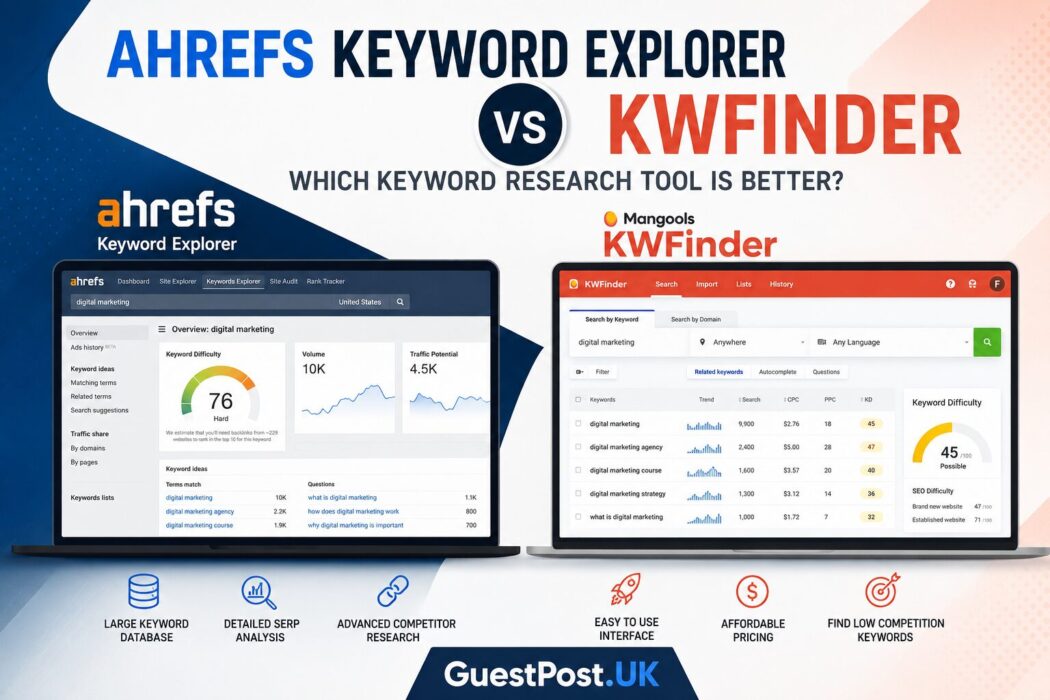
Two tools that frequently appear in discussions are Ahrefs Keyword Explorer and KWFinder. While both help users discover keyword opportunities, analyse search intent and evaluate competition, they take very different approaches. Ahrefs positions itself as an all-in-one SEO platform with enterprise-level data, whereas KWFinder, part of the Mangools suite, focuses on making keyword research simple, affordable and accessible.
If you’re wondering whether Ahrefs vs KWFinder is a fair comparison, the answer is yes. Both tools solve the same core problem but cater to different types of users. Understanding those differences can save you money, improve your workflow and help you choose software that matches your SEO goals.
This comparison explores everything that matters, including keyword databases, search volume accuracy, keyword difficulty, SERP analysis, pricing, usability and practical use cases, so you can decide which platform deserves a place in your SEO toolkit.
Ahrefs Keyword Explorer vs KWFinder at a Glance
| Feature | Ahrefs Keyword Explorer | KWFinder |
|---|---|---|
| Best For | Agencies, advanced SEOs, large websites | Bloggers, freelancers, small businesses |
| Ease of Use | ★★★★☆ | ★★★★★ |
| Keyword Database | Excellent | Very Good |
| Keyword Difficulty | Advanced | Beginner-friendly |
| SERP Analysis | Excellent | Good |
| Competitor Research | Excellent | Good |
| Backlink Integration | Full suite | Limited |
| Long-tail Keywords | Excellent | Excellent |
| Pricing | Premium | Budget-friendly |
| Learning Curve | Medium | Very Easy |
At first glance, both platforms appear capable of finding profitable keywords. The real difference lies in how much context they provide around those keywords and how they fit into a complete SEO workflow.
What Is Ahrefs Keyword Explorer?
Ahrefs Keyword Explorer is one component of the wider Ahrefs SEO platform. It allows users to discover keyword ideas, estimate search volume, analyse keyword difficulty, understand search intent and evaluate the pages already ranking on Google.
Unlike many standalone keyword research tools, Ahrefs integrates keyword data with backlink analysis, content research and competitor intelligence. This means you can move from discovering a keyword to analysing the websites dominating that topic without leaving the platform.
For experienced SEO professionals, this integrated workflow can save considerable time when planning campaigns.
Where Ahrefs Excels
- Extensive keyword database covering numerous countries
- Reliable SERP analysis
- Advanced competitor keyword research
- Click metrics alongside search volume
- Parent Topic recommendations
- Excellent integration with backlink data
An SEO agency managing several clients can quickly identify high-value keywords, analyse the strongest competitors, and determine the type of content required to compete.
What Is KWFinder?
KWFinder is the keyword research tool within the Mangools SEO suite. Its biggest strength is simplicity.
Instead of overwhelming users with hundreds of filters and advanced metrics, KWFinder focuses on helping people quickly discover keyword opportunities. The interface is clean, intuitive and particularly suitable for those new to SEO.
Although it doesn’t provide the same depth of competitor intelligence as Ahrefs, it delivers enough information for most blogs, local businesses and smaller websites.
Why Many Beginners Prefer KWFinder
KWFinder removes much of the complexity associated with keyword research.
Users can:
- Find long-tail keywords
- View search volumes
- Estimate keyword difficulty
- Analyse basic SERP competition
- Discover related keyword suggestions
For someone publishing regular blog content, this is often more than enough.
Ahrefs vs KWFinder: Keyword Database Comparison
The quality of any keyword research software depends heavily on its underlying database.
Ahrefs has invested heavily in maintaining one of the largest keyword databases available. It tracks billions of keywords across multiple countries and continually updates its index.
KWFinder also offers an impressive database, particularly for English-speaking markets, but its scale is smaller.
Why Database Size Matters
Imagine you’re researching an emerging topic within AI SEO.
A larger database is more likely to uncover:
- newly trending keywords
- niche variations
- question-based searches
- semantic keyword opportunities
For highly competitive industries, these additional keyword ideas can become valuable content opportunities before competitors notice them.
Winner
In terms of database size and breadth, Ahrefs Keyword Explorer has the advantage.
For everyday blogging and local SEO campaigns, however, KWFinder remains highly capable.
Keyword Difficulty: Which Tool Is More Reliable?
Keyword Difficulty (KD) is one of the first metrics SEO professionals examine before deciding whether to target a keyword.
Although both tools provide a keyword difficulty score, they calculate it differently.
Ahrefs Keyword Difficulty
Ahrefs primarily bases keyword difficulty on the backlink profiles of pages already ranking on Google’s first page.
This approach works well because backlinks remain one of Google’s strongest ranking signals.
However, backlink strength isn’t the only ranking factor.
Content quality, topical authority, search intent and user experience also influence rankings.
Experienced SEOs, therefore, treat Ahrefs KD as an indicator rather than a guarantee.
KWFinder Keyword Difficulty
KWFinder uses its own methodology while presenting the results in a very approachable way.
Rather than overwhelming users with technical metrics, it provides an easy-to-understand difficulty score that helps beginners prioritise opportunities.
For bloggers publishing informational content, this simplified approach often speeds up decision-making.
Which Keyword Difficulty Score Should You Trust?
Neither score should be treated as absolute truth.
Instead:
- Use keyword difficulty as a starting point.
- Manually review the first page of Google.
- Analyse search intent.
- Compare content quality.
- Assess the domain authority of competitors.
The most successful SEO campaigns combine software metrics with human judgement.
Search Volume Accuracy
One question every SEO professional eventually asks is:
Can keyword search volume actually be trusted?
The reality is that every SEO platform estimates search volume differently.
Google does not publish exact monthly search figures, so companies build their own models using clickstream data, historical trends and proprietary algorithms.
Ahrefs
Ahrefs tends to provide more detailed supporting metrics alongside search volume, including:
- clicks
- return rate
- parent topic
- traffic potential
This additional context often proves more useful than the search volume itself.
For example, two keywords may each show 2,000 monthly searches, yet one generates significantly more clicks because Google displays fewer featured snippets and AI summaries.
KWFinder
KWFinder focuses on delivering clear search volume estimates without overwhelming users.
For most websites, these estimates are accurate enough for planning content calendars and identifying promising opportunities.
If your objective is to publish high-quality articles rather than to model enterprise SEO campaigns, the differences may be negligible.
SERP Analysis Comparison
One area where Ahrefs begins to separate itself is SERP analysis.
Rather than simply listing competing pages, it provides deeper insights into why those pages rank.
You can quickly review:
- referring domains
- estimated traffic
- backlinks
- keyword overlap
- ranking history
- content strength
This context allows experienced SEO professionals to judge whether a keyword is genuinely achievable.
KWFinder also includes useful SERP metrics, but they’re intentionally simplified.
That simplicity works well for users who simply want to know whether they can realistically compete without spending time analysing dozens of SEO metrics.
Competitor Keyword Research
If competitor analysis is central to your SEO strategy, Ahrefs offers a clear advantage.
Suppose a competing website suddenly begins attracting substantial organic traffic.
Using Ahrefs, you can investigate:
- newly ranking keywords
- traffic growth
- top-performing pages
- backlink acquisition
- keyword gaps
- content opportunities
This creates an efficient framework for developing content that targets proven search demand rather than relying on guesswork.
KWFinder includes competitor research capabilities, but they’re designed more for discovering keyword opportunities than for conducting comprehensive competitive intelligence.
For agencies managing multiple SEO campaigns, this distinction can make a noticeable difference in day-to-day workflow.
Long-Tail Keyword Research: Which Tool Finds Better Opportunities?
Long-tail keywords are often where the biggest SEO wins happen. They typically have lower competition, clearer search intent and higher conversion potential than broad keywords.
Both Ahrefs Keyword Explorer and KWFinder can discover long-tail phrases, but they approach the task differently.
Ahrefs Keyword Explorer
Ahrefs generates keyword ideas from multiple reports, including:
- Matching Terms
- Related Terms
- Search Suggestions
- Questions
- Also Rank For
This gives experienced SEOs a broad pool of keyword opportunities. You can quickly identify supporting topics and build comprehensive content clusters around a primary keyword.
For example, if you’re targeting guest posting services, Ahrefs may uncover related searches such as:
- guest posting services UK
- affordable guest posting services
- white label guest posting
- guest blogging services
- guest posting outreach service
These variations make it easier to create topical authority rather than to focus on a single keyword.
KWFinder
KWFinder shines when you want straightforward keyword ideas without spending time filtering large datasets.
It presents keyword suggestions in a clean interface with useful metrics alongside each phrase, making it particularly suitable for bloggers and small business owners.
If you’re writing five to ten articles each month, KWFinder often provides more than enough keyword inspiration without unnecessary complexity.
Which Tool Wins?
If your goal is to build large topical clusters or plan enterprise SEO campaigns, Ahrefs has the advantage.
If you simply want to find profitable long-tail keywords quickly, KWFinder remains an excellent choice.
User Experience and Ease of Use
A powerful SEO tool isn’t always the most productive if it takes weeks to learn.
This is where the two platforms differ considerably.
Ahrefs
Ahrefs offers a feature-rich dashboard packed with reports, filters and advanced metrics.
For experienced users, this depth is invaluable. However, beginners may initially find the interface overwhelming, especially when confronted with metrics such as URL Rating (UR), Domain Rating (DR), traffic potential, referring domains and click data.
There is a learning curve, but the reward is access to one of the most comprehensive SEO platforms available.
KWFinder
KWFinder was designed with simplicity in mind.
The interface is uncluttered, navigation is intuitive, and the most important metrics are immediately visible.
Someone completely new to keyword research can begin finding opportunities within minutes.
This ease of use is one reason many freelancers, bloggers and local businesses choose KWFinder over more complex alternatives.
Ahrefs vs KWFinder Pricing
Pricing is often the deciding factor, particularly for freelancers and growing businesses.
Ahrefs
Ahrefs is positioned as a premium SEO platform.
Although the subscription cost is higher, it combines multiple tools into one ecosystem, including:
- Keyword Explorer
- Site Explorer
- Site Audit
- Rank Tracker
- Content Explorer
- Backlink Analysis
For agencies and businesses managing several SEO campaigns, this broader functionality can justify the investment.
KWFinder
KWFinder is considerably more affordable.
Since it forms part of the Mangools suite, subscribers also gain access to additional SEO tools for SERP analysis, backlink checking and rank tracking.
For individuals or small teams, this often provides excellent value for money.
Which Offers Better Value?
The answer depends on your requirements.
If keyword research is only one part of your SEO workflow, Ahrefs may reduce the need for several separate subscriptions.
If you’re primarily creating content and researching keywords, KWFinder delivers impressive value at a lower price point.
Pros and Cons
Ahrefs Keyword Explorer
Pros
- Extensive keyword database
- Outstanding competitor research
- Excellent SERP analysis
- Advanced keyword filtering
- Accurate backlink integration
- Ideal for large SEO campaigns
Cons
- Higher monthly cost
- Steeper learning curve
- More features than many beginners require
KWFinder
Pros
- Extremely user-friendly
- Affordable pricing
- Excellent long-tail keyword discovery
- Fast keyword research workflow
- Ideal for bloggers and freelancers
Cons
- Smaller keyword database
- Limited competitor analysis
- Fewer advanced SEO insights
- Not as suitable for enterprise campaigns
Ahrefs vs KWFinder: Best Use Cases
Choosing the right tool depends less on which platform is “better” and more on how you work.
Choose Ahrefs if you:
- Manage SEO for multiple clients.
- Run a digital marketing agency.
- Need advanced competitor analysis.
- Build large content strategies.
- Rely heavily on backlink research.
- Want an all-in-one SEO platform.
Choose KWFinder if you:
- Are new to SEO.
- Manage your own website or blog.
- Publish content regularly.
- Focus on local SEO.
- Need reliable keyword research without a premium price tag.
- Prefer a clean, intuitive interface.
Is KWFinder a Good Alternative to Ahrefs?
This is one of the most common questions people ask before investing in SEO software.
The answer depends on your expectations.
If you’re looking for a KWFinder alternative to Ahrefs that delivers enterprise-level competitor research, backlink analysis and comprehensive SEO intelligence, you’ll likely notice the limitations.
However, if your primary objective is discovering keyword opportunities, analysing search difficulty and planning content, KWFinder performs remarkably well.
Many bloggers and niche website owners never need the advanced functionality that Ahrefs offers.
In that sense, KWFinder is a practical and cost-effective alternative to Ahrefs for content-focused SEO.
Mangools vs Ahrefs: How Does the Bigger Picture Compare?
Because KWFinder is part of the Mangools ecosystem, it’s worth considering the broader comparison.
Mangools includes:
- KWFinder
- SERPChecker
- SERPWatcher
- LinkMiner
- SiteProfiler
Together, these tools cover many everyday SEO tasks while remaining affordable and beginner-friendly.
Ahrefs, by comparison, delivers a more comprehensive platform aimed at professionals managing larger websites, international SEO campaigns and in-depth competitive research.
For smaller businesses, Mangools may provide everything required without stretching the budget.
Text-Based Trend Comparison
Imagine a scale measuring the complexity of your SEO requirements.
Basic blog → Local business → Small eCommerce → Growing affiliate site → Digital agency → Enterprise SEO
On this scale:
- KWFinder performs exceptionally well from beginner level through to small and medium-sized websites.
- Ahrefs becomes increasingly valuable as projects grow in complexity, competition and scale.
The larger your website and the more competitive your industry, the greater the advantage Ahrefs’ broader dataset and advanced analytical tools offer.
Frequently Asked Questions
Which is better: Ahrefs Keyword Explorer or KWFinder?
Neither tool is universally better. Ahrefs is ideal for agencies and experienced SEO professionals who require detailed competitor analysis and backlink data. KWFinder is better suited to beginners, bloggers and small businesses seeking an affordable, easy-to-use keyword research tool.
Is KWFinder accurate for keyword research?
Yes. KWFinder provides reliable keyword suggestions, search volume estimates and keyword difficulty scores for most SEO projects. While its database is smaller than Ahrefs’, it is more than sufficient for many content marketing strategies.
Does Ahrefs have a larger keyword database?
Yes. Ahrefs maintains one of the largest keyword databases in the SEO industry, covering billions of keywords across numerous countries. This allows it to uncover a wider range of keyword opportunities and emerging search trends.
Is KWFinder worth it for beginners?
Absolutely. KWFinder’s simple interface, clear metrics and affordable pricing make it one of the easiest keyword research tools to learn, especially if you’re just starting your SEO journey.
Which tool is better for competitor analysis?
Ahrefs is the stronger choice. Its detailed competitor reports, backlink analysis, keyword gap tools and traffic estimates provide a much deeper understanding of how competing websites achieve their rankings.
Can I use KWFinder instead of Ahrefs?
Yes, if your primary focus is keyword research and content planning. However, businesses that require advanced backlink analysis, comprehensive site audits or enterprise-level SEO reporting will generally benefit more from Ahrefs.
Final Words: Ahrefs Keyword Explorer vs KWFinder
The comparison between Ahrefs Keyword Explorer vs KWFinder isn’t about finding a single winner—it’s about choosing the tool that aligns with your SEO goals.
If you’re an agency, experienced SEO consultant or business managing competitive search campaigns, Ahrefs Keyword Explorer is difficult to beat. Its extensive keyword database, advanced SERP analysis, competitor intelligence and seamless integration with the wider Ahrefs platform make it a powerful investment for serious SEO work.
On the other hand, KWFinder proves that effective keyword research doesn’t have to be complicated or expensive. Its intuitive interface, excellent long-tail keyword suggestions, and affordable pricing make it an outstanding choice for bloggers, freelancers, local businesses, and anyone building a website without needing enterprise-level features.
Ultimately, the best keyword research tool depends on your workflow, experience and budget. If you need deep SEO intelligence and comprehensive analysis, Ahrefs is the stronger option. If your priority is finding profitable keywords quickly and efficiently, KWFinder offers exceptional value and remains one of the best alternatives available.