
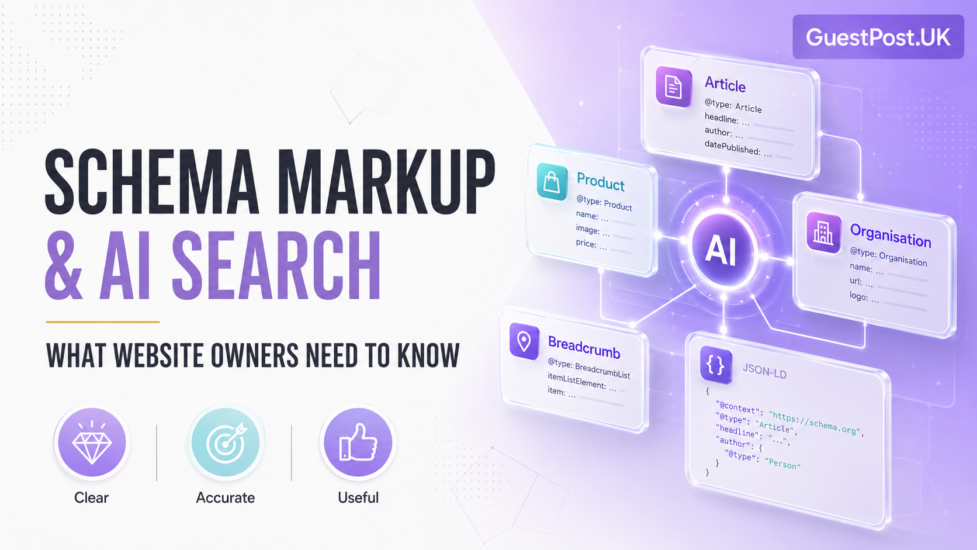
Schema markup has become one of the most misunderstood parts of AI search optimisation.
Some website owners assume that adding more schema will make ChatGPT, Google AI Mode or AI Overviews cite their pages. Others dismiss structured data completely because it does not guarantee a rich result, a ranking increase or an AI mention.
Neither view is quite right.
Schema markup is useful because it gives search engines explicit, machine-readable clues about the content on a page. It can identify an organisation, product, article, breadcrumb trail, event, course, review or other structured information. It can also help pages become eligible for certain enhanced appearances in Google Search.
What it does not do is act as a secret “AI citation” switch.
Google is explicit on this point: structured data is not required for generative AI search, and there is no special schema.org markup needed to appear in AI Overviews or AI Mode. It remains worthwhile as part of a sound SEO strategy, but it should not replace clear content, crawlability or genuine expertise. Google Search Central
The most sensible approach is to use schema accurately, maintain it carefully and understand its limits.
What Schema Markup Actually Does
Schema markup, often called structured data, is code added to a webpage to describe what the page contains.
A recipe page, for example, can display the recipe name, ingredients, cook time, nutrition information, and reviews. A product page can identify a product’s name, price, availability, brand and ratings. An article can identify its headline, author, image and publication date.
Google explains that structured data provides explicit clues about a page’s meaning and can enable more engaging search results, known as rich results. Google’s structured data guide
The key phrase is explicit clues.
A search engine can often understand a page without schema. Structured data makes certain details easier to interpret and classify when the code is valid, relevant and supported.
Schema is not the same as page content
The visible page remains the primary source of information for visitors and search engines. Schema should describe what is already present, not invent information that users cannot see.
If a page claims to offer a service, it needs a clear explanation of that service. Adding Service or Organization schema cannot make an otherwise thin sales page authoritative.
A useful way to think about the relationship is:
- Visible content: explains the service, product, guide or business to people.
- Technical SEO: ensures the page can be crawled and indexed.
- Schema markup: labels relevant facts in a structured format.
- Authority signals: help demonstrate why the source should be trusted.
All four work better together.
Do Google AI Mode and AI Overviews Use Schema Markup?
Google has not said that structured data is a direct ranking factor or an AI citation requirement.
For AI features, Google’s published requirements remain familiar: a page needs to be indexed, be eligible to appear in Search with a snippet, and comply with Search technical requirements. Google’s AI features documentation
That does not mean schema is irrelevant. Structured data can support the broader signals that make a website clearer and more usable in Search.
For example:
- Accurate product markup can support product information in Google Search.
- Breadcrumb markup can clarify a page’s place in a site hierarchy.
- Article markup can identify the content type, headline and dates.
- Organisation markup can help establish consistent business information.
- Local business markup can reinforce details shown on a location page.
But schema alone does not turn an average page into a useful source. AI-led results still need relevant, accessible and helpful information.
The practical answer
AI search tools may benefit indirectly from well-structured, accurate website data, but there is no evidence that adding special schema guarantees AI citations or visibility.
Use schema because it accurately supports your SEO, product, content and entity information. Do not use it as a shortcut around weak copy, poor technical setup or missing expertise.
What About ChatGPT Search and Other AI Tools?
Search-enabled AI tools can retrieve and cite public web sources, but they do not publish a universal schema checklist that guarantees inclusion.
For ChatGPT search, the first practical requirement is accessibility. OpenAI states that public websites can appear in ChatGPT search, and publishers wanting their content included in summaries and snippets should ensure they are not blocking OAI-SearchBot. OpenAI’s publisher FAQ
A well-marked-up page may be easier to interpret in a general sense, but the main priorities remain:
- Useful and original information
- Public, crawlable pages
- Clear page titles and headings
- Accurate business and product data
- Strong internal linking
- A reliable technical setup
- Information that directly answers a real question
Schema is one supporting layer, not the full AI search strategy.
The Schema Types Most Website Owners Should Prioritise
Rather than adding every available schema type, start with those that genuinely reflect the page and the business.
Organisation schema
Organisation markup is useful for a company’s core identity. It can describe the business name, logo, URL, contact details and social profiles where applicable.
This is particularly worthwhile for agencies, publishers, ecommerce brands and service businesses that want a consistent entity presence across their website.
Keep the details aligned with the Contact page, About page, footer and external business profiles. Inconsistent business information is more damaging than having no elaborate markup at all.
Website and WebPage schema
These are broad descriptive types that can help establish what a site or individual page is. They are often implemented automatically by reputable SEO plugins.
They are rarely the most exciting part of a schema strategy, but they provide a sensible baseline when configured correctly.
Article schema
For blog posts, guides, news content and editorial resources, Article, BlogPosting or NewsArticle markup can identify core information such as the headline, author, publication date, modified date and featured image.
This is useful for content-led websites because it makes the article’s basic facts easier to identify and maintain. Make sure the dates are genuine, and the author information represents a real person or a transparent editorial entity.
For GuestPost.UK, article schema should support the visible post title, publication details, featured image and author structure across the blog, without adding false review or rating information.
Breadcrumb schema
Breadcrumb markup helps describe the hierarchy of a page within the wider website.
For example:
Home > SEO Services > Technical SEO > AI Search Checklist
Google says breadcrumb trails can help users understand and explore site hierarchy, while breadcrumb markup can be used to categorise information in search results. Google’s breadcrumb documentation
This is useful for large sites with services, academy content, tools, category pages and product sections. It also reinforces clean internal architecture.
Product and merchant listing schema
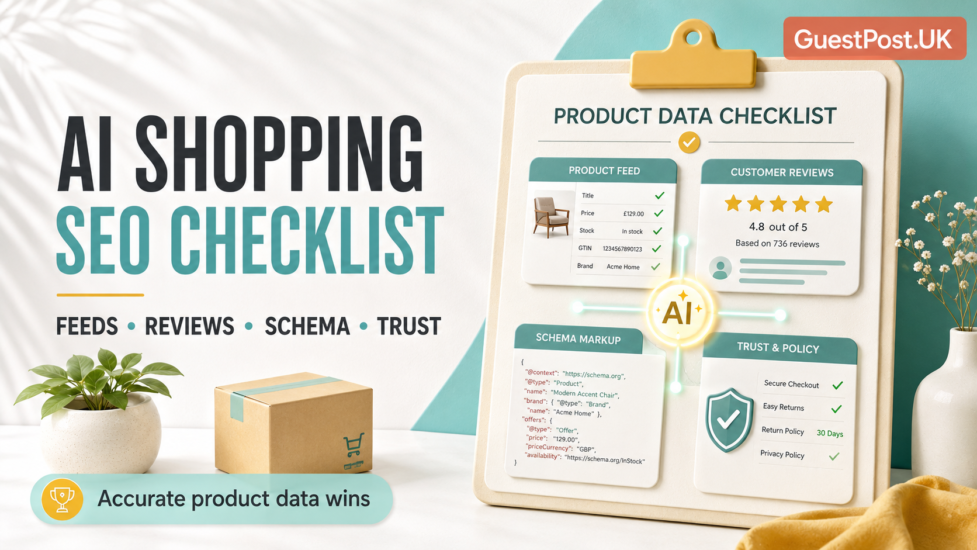
For ecommerce websites, accurate product markup is a priority. It can help communicate product information, such as price, availability, reviews, and shipping details, when those details are genuinely present and up to date.
Do not rely on product schema alone for AI shopping visibility. The product page itself needs useful descriptions, clear specifications, accurate images, genuine reviews and reliable stock data. Merchant feeds and business data may also be relevant, depending on the platform and market.
Local business schema
Businesses serving a defined location can use LocalBusiness markup to reinforce publicly visible details such as business name, address, telephone number, opening hours and service area.
It should match the information on the site and the business’s Google Business Profile. For local SEO, consistency is more valuable than trying to add every optional property.
FAQ and Q&A schema
Question-and-answer content can be helpful for readers, but schema should be used carefully.
A genuine Q&A page, where users submit questions and answers, may be suitable for QAPage markup. Google describes this as a page containing a question followed by answers. Google’s Q&A structured data documentation
An ordinary service-page FAQ is not the same thing as a user-generated Q&A forum. Use the schema type that best matches the page rather than selecting one because it appears commercially attractive.
More importantly, write useful answers whether or not a rich result appears. The question-and-answer section should solve a buyer’s concern, not exist solely to add extra markup.
JSON-LD vs Microdata vs RDFa
Google supports three structured data formats:
- JSON-LD
- Microdata
- RDFa
For most site owners, JSON-LD is the practical choice. It is typically added as a script block and does not require adding attributes throughout visible HTML elements.
Google recommends JSON-LD when a site setup supports it, as it is generally easier to implement and maintain at scale. Google’s structured data policies
Why JSON-LD is easier to manage
On a WordPress website, a plugin or theme can often automatically generate JSON-LD from page details. This makes it easier to update a company name, author, product data or featured image without editing numerous template elements.
Microdata and RDFa can work well in certain technical environments, but they are more tightly connected to HTML markup. That can create maintenance difficulties on large content sites or frequently updated ecommerce catalogues.
The best format is the one that produces accurate, visible-content-aligned data and can be maintained properly by your website team.
Schema Markup Mistakes That Can Damage Trust
Bad schema is worse than no schema when it misrepresents the page.
Google’s structured data guidelines require markup to be relevant, complete, current and representative of visible content. It must not include misleading information or fake reviews. Google Search Central
Watch for these common problems.
Marking up information users cannot see
If your schema says a product costs £99, the visible page should show the same valid price. If it identifies a review rating, the review content and rating should be genuinely available on the page.
Hidden or invented information can render the markup ineligible for rich results and may raise broader quality concerns.
Using the wrong type for the page
A guide about SEO services is not a product. A standard FAQ block is not automatically a Q&A forum. An opinion article is not a news report simply because NewsArticle sounds more authoritative.
Select the most specific type that truthfully describes the main page purpose.
Leaving outdated template data live
Schema errors are often caused by template changes rather than individual pages. An old price, removed author, expired event date or image URL can remain in JSON-LD even after the visible page is updated.
Review schema after changing themes, SEO plugins, WooCommerce settings, page templates or custom code.
Duplicated or conflicting markup
More markup does not necessarily mean better markup. Two plugins may output competing organisation data, duplicate product schema or conflicting article fields.
This is common when an SEO plugin, an ecommerce plugin, a theme, and a page builder all attempt to add schema. Audit the source code and remove unnecessary overlap.
How to Audit Your Website’s Schema Markup
A schema audit should combine automated tests with editorial review.
1. Identify the page type
Choose a sample of high-value pages:
- Homepage
- About page
- Core service pages
- Blog post templates
- Ecommerce product pages
- Product category pages
- Local location pages
- Course, event or resource pages where applicable
For each page, ask what the primary content type actually is. The schema should follow this purpose.
2. Test with Google’s Rich Results Test
Google recommends using the Rich Results Test to see which Google rich results may be generated for a page. It can identify syntax errors, missing required fields and supported rich-result types. Google’s testing guidance
This test does not guarantee an enhanced result will appear. It only confirms whether the markup is technically eligible.
3. Inspect the rendered page in Search Console
Use URL Inspection to confirm that Google can access the page and see the relevant rendered content. Schema cannot help if the page is blocked by robots.txt, prevented from indexing or hidden behind a login wall.
4. Compare markup against visible content
This is where human review matters. Check names, images, offers, prices, author details, ratings, dates and business information line by line.
5. Monitor the relevant Search Console reports
After deploying markup, review Search Console’s rich-result reports for valid items, warnings and errors. Google recommends checking these after first implementation, template releases and significant code updates. Google Search Central
The Schema Trend to Watch
Schema improvements should be measured as a chain of evidence, not a direct promise of rankings.
- Markup becomes valid → Google can process eligible content types more reliably.
- Valid items increase → template deployment is working across the intended pages.
- Relevant search appearance improves → enhanced results may be helping the page stand out.
- CTR improves on affected page groups → users may find the result clearer or more relevant.
- No change in traffic → review the query demand, page quality and overall ranking position rather than adding more markup blindly.
Google makes no guarantee that correct structured data will appear as a rich result. Search appearance is shaped by many variables, including query context, location, device and what Google considers most useful for the user. Google’s structured data policies
That is why schema work should be tested over time and compared with similar pages.
A Practical Priority Order for Small Businesses
If you run a small service website, do not begin by trying to implement ten schema types.
Start with:
- Accurate Organisation or LocalBusiness markup.
- Website and WebPage baseline markup.
- Breadcrumb markup for clear site hierarchy.
- Article markup for useful blog content.
- Service-page content that clearly explains the offer.
- Product markup only where genuine products are sold.
- Regular checks after plugin or template changes.
For a WordPress website, an established SEO plugin may already handle much of this. The important task is to review its output, ensure it matches the visible page, and prevent duplicate schema from other plugins or themes.
Treat Schema as a Clarity Tool, Not a Shortcut
Structured data works best when it reinforces an already well-built page.
Give users useful information first. Keep facts accurate. Make core pages crawlable and easy to navigate. Then use schema to label the details that genuinely deserve a machine-readable format.
That approach can improve search-result eligibility, help maintain clean entity information and support a stronger technical SEO foundation. It is far more sustainable than chasing a special markup type that promises instant AI visibility but does not exist.