

AI agents are changing how SEO teams work. Unlike a basic chatbot that answers one prompt at a time, an AI agent can follow a defined workflow: gather information, organise findings, produce a draft, flag gaps and prepare the next task for human review.
For SEO agencies and in-house teams, that can save significant time on repetitive work. An agent can help build keyword lists, summarise competitor pages, organise Search Console data, create content briefs or prepare the first version of an outreach email. The important point is that it should support expert judgement, not replace it.
The best AI agents for SEO are not necessarily the tools with the biggest promises. They are the ones that follow a real process, use reliable data, and include clear quality checks before anything is published or sent.
What is an AI agent for SEO?
An AI agent for SEO is a tool or automated workflow that can complete multi-step tasks with defined instructions, data sources and goals.
For example, instead of asking an AI tool to “find keywords”, an SEO research agent could:
- Review a target service page
- Analyse Google Search Console queries
- Compare competitor topic coverage
- Group search terms by intent
- Identify gaps and opportunities
- Produce a prioritised content brief
This is more useful than a long unfiltered keyword list. It turns information into a decision-ready output.
The same principle applies to content, reporting, technical SEO and outreach. An agent is only as strong as its inputs, instructions and review process. If it receives inaccurate data or vague prompts, it can confidently produce poor recommendations.
Good AI agents reduce repetitive work. Good SEO specialists decide whether the output is accurate, useful and commercially worthwhile.
AI agents for SEO research
Research is one of the best places to begin because it involves many repeatable tasks: collecting search terms, reviewing competitor pages, grouping themes and identifying missed opportunities.
ChatGPT and custom GPT workflows
ChatGPT works well as a flexible research assistant when given reliable source material. You can upload exports from Search Console, keyword tools or competitor analysis, then ask it to categorise terms by intent, identify recurring questions and build a content opportunity list.
A useful workflow might include:
- Search Console queries from the last six months
- Competitor page titles and headings
- Existing website URLs
- Target audience information
- Commercial priorities and locations
The agent can then identify pages to improve, new guides to create, and internal links to add. It should not invent keyword volumes or competitor rankings. Verify those facts in first-party data or a trusted SEO platform.
For a stronger starting point, combine agent research with a dedicated keyword research service. The agent can speed up sorting and briefing, while the strategy remains grounded in real search opportunity.
Claude for long documents and structured analysis
Claude is particularly useful when you need to review lengthy documents, research notes, transcripts or large collections of competitor content. It can summarise patterns, create structured recommendations and help turn a messy research process into a usable outline.
This makes it helpful for:
- Content audits
- Topic cluster planning
- Competitor messaging analysis
- Long-form brief preparation
- Brand and tone-of-voice analysis
Use it to find patterns, not to make unverified claims. The final strategy should still be checked against rankings, Search Console data, customer feedback and actual competitor pages.
Perplexity for cited topical research
Perplexity can help collect an initial research pack with visible sources. It is useful when researching a new topic, an industry trend, or a supporting statistic for a content brief.
However, being cited does not automatically mean it is correct. Always open and assess the original source, especially for medical, legal, financial or highly commercial statements. An AI agent can surface research efficiently, but a writer or strategist should decide whether that source genuinely supports the claim.
AI agents for content planning and optimisation
Content agents are often misunderstood. Their value is not in producing hundreds of articles quickly. Their real value is helping teams create better briefs, improve existing pages and reduce repetitive editorial work.
Content brief agents
A good content brief agent can combine target keywords, customer questions, competitor themes, required proof and internal-link opportunities into a structured brief.
A practical SEO content brief should include:
- Primary search intent
- Audience and commercial goal
- Suggested title and angle
- Priority subtopics
- Questions and objections to answer
- Internal links to add
- Evidence or examples required
- Competitor weaknesses to improve upon
- Clear call to action
GuestPost.UK’s SEO content brief generator can support this stage, but the brief still needs a human editor. Every article should have a distinct angle, useful examples and a reason to exist beyond repeating what competitors have already written.
Content refresh agents
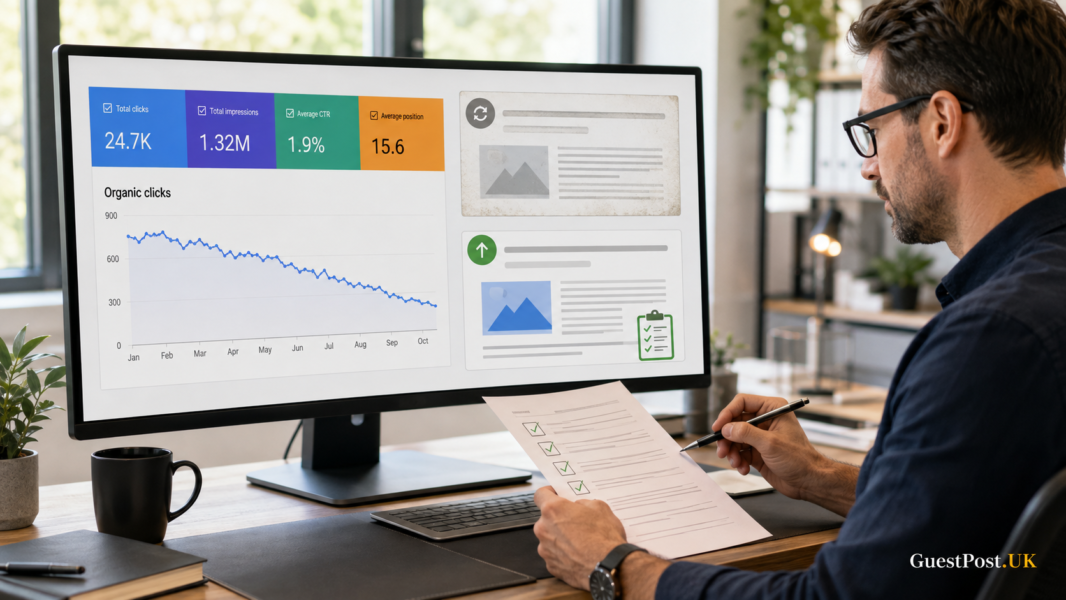
An agent can review a declining page alongside Search Console data and suggest:
- Missing subtopics
- Outdated statistics or examples
- Questions now appearing in search
- Weak headings and vague sections
- Internal links to related pages
- Opportunities to improve clarity and conversions
This is particularly useful for agencies managing large websites. Instead of manually reviewing hundreds of URLs, the agent can prioritise pages showing falling clicks, poor click-through rate or emerging competitor pressure.
Do not allow automated refreshes to overwrite high-performing content without review. Protect strong sections, unique expertise and existing rankings.
AI agents for SEO reporting
Reporting is often repetitive but essential. An agent can turn raw exports into a useful client narrative when it is given accurate data and a sensible structure.
A reporting agent can help:
- Summarise Search Console trends
- Flag meaningful changes in clicks and impressions
- Group keyword wins and declines
- Compare priority page performance
- Identify indexation or technical issues
- Draft monthly campaign notes
- Prepare action priorities for the next period
The key word is “meaningful”. A good report does not celebrate tiny movement from a low-volume query or claim that a small increase in impressions proves success.
Use an agent alongside a monthly SEO report generator or your reporting dashboard, then edit the narrative with professional judgement. Explain what changed, what likely influenced it, what needs attention and what the team will do next.
AI agents for technical SEO
Technical SEO agents can help identify patterns in crawl exports, audit data and site structures. They are especially useful when dealing with thousands of URLs, repeated templates or large spreadsheets.
Common use cases include:
- Grouping crawl errors by type
- Identifying missing or duplicated metadata
- Finding internal linking gaps
- Prioritising pages with poor indexation signals
- Summarising redirect chains
- Reviewing structured page data
- Turning audit findings into developer tickets
An AI agent should not make production-level technical changes on its own. It may misunderstand site architecture, incorrectly classify pages or suggest risky fixes. Use it to organise evidence and speed up diagnosis, then have an experienced SEO specialist verify the recommendation.
AI agents for guest post prospecting and outreach
AI can help make outreach more efficient, but this is also where careless automation can damage relationships.
A prospecting agent can assist with:
- Building a seed list of relevant publication types
- Grouping websites by niche, country or audience
- Identifying likely editorial angles
- Drafting a first outreach structure
- Tracking reply themes
- Preparing follow-up tasks
It should not be trusted to decide whether a site is genuinely high-quality, traffic-bearing, or relevant. It can also invent contact details, misread a publisher’s guidelines or create generic emails that look automated.
Human review is essential for every prospect. Check the website’s audience, editorial quality, topical relevance, live content, traffic signals and linking standards before making contact.
For outreach messages, use AI to create a starting point, then personalise it using genuine information from the publication. The outreach email generator can save time on drafting, but relevance and credibility determine whether an editor replies.
The best AI agent workflows for agencies
The most effective agencies do not use one enormous AI agent for every task. They build focused workflows with clear input, output, and quality checks.
| Workflow | Agent role | Human review |
|---|---|---|
| Keyword research | Group queries and identify intent | Validate opportunity and commercial relevance |
| Content briefs | Structure topics, questions and gaps | Set strategy, examples and editorial angle |
| Content refreshes | Flag weak or outdated areas | Protect quality and approve edits |
| Reporting | Summarise performance changes | Check claims and prioritise actions |
| Technical audits | Cluster issues and draft tickets | Verify fixes before implementation |
| Outreach | Research angles and draft emails | Vet sites and personalise every message |
This approach is safer, easier to measure and far more useful than blindly automating an entire campaign.
Quality checks every SEO agent needs
Before publishing, sending or acting on an agent’s output, check:
- Is the source data current and accurate?
- Has the agent invented any facts, statistics or URLs?
- Does the recommendation align with the business’s actual audience?
- Is the content genuinely useful rather than repetitive?
- Are internal links relevant and natural?
- Does the outreach message reference real information?
- Could the action affect rankings, data, reputation or relationships?
- Has a qualified person approved the final version?
For answer-engine visibility work, agents should also help assess how clearly your content explains entities, services, evidence and audience fit. That supports both SEO and answer engine optimisation.
Put agents to work without losing quality
Start with one recurring bottleneck. It might be building content briefs, preparing monthly reports or sorting outreach prospects. Document the current process, identify the repetitive stages and create an agent workflow with clear approval points.
Measure the result by time saved, quality of output and business impact. If the agent saves two hours but creates weak briefs that need another three hours of correction, it has not improved the process.
The best AI agents for SEO make teams more focused. They create more time for the work that requires real experience: building strategy, evaluating quality, understanding clients, forming publisher relationships and deciding what deserves to rank.