
“Most businesses know what they spend on guest posting. Far fewer know what they actually earn from it.”
Every year, businesses invest thousands of pounds into guest posting campaigns.
Some spend a few hundred pounds on occasional placements. Others invest tens of thousands into large-scale outreach, digital PR, and authority-building campaigns.
Regardless of budget, one question always appears eventually:
Was it worth it?
Surprisingly, many businesses struggle to answer this question.
They know how many links they acquired.
They know how much they spent.
They may even know the Domain Authority (DA) or Domain Rating (DR) of the websites where their content was published.
Yet they often cannot clearly explain the actual business return generated by those backlinks.
This is where guest posting ROI becomes important.
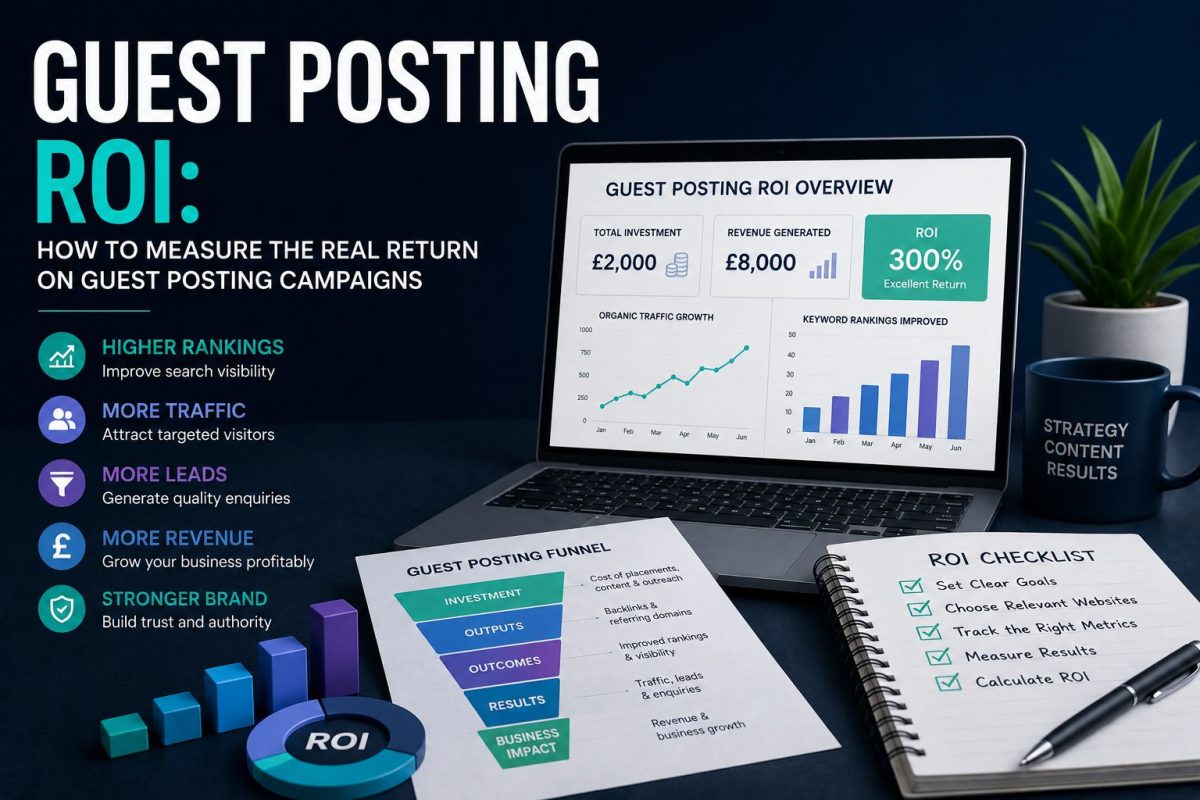
Return on Investment (ROI) allows businesses to move beyond vanity metrics and focus on what really matters: rankings, traffic, enquiries, customers, and revenue.
In this guide, we will explore how guest posting ROI works, how to calculate it correctly, which metrics matter most, and how successful businesses evaluate the true value of guest posting campaigns.
What Is Guest Posting ROI?
Guest posting ROI refers to the measurable return generated from investing in guest posting activities.
The investment may include:
- Guest post placements
- Outreach costs
- Content creation
- SEO consultancy
- Link building campaigns
- Agency fees
The return may include:
- Higher search rankings
- Increased organic traffic
- More enquiries
- More sales
- Stronger brand awareness
- Greater online authority
Many businesses mistakenly believe that ROI refers only to direct revenue.
In reality, guest posting can produce both direct and indirect returns.
For example, a backlink may not generate immediate sales, but it could improve rankings for important keywords, which could eventually drive significant business growth.
The key is to understand the full impact rather than focus on a single metric.
Why Businesses Often Miscalculate Guest Posting ROI
One of the biggest reasons businesses become disappointed with guest posting is that they measure success incorrectly.
Focusing Only on Backlinks
Many reports highlight:
- Number of links built
- Domain Authority
- Domain Rating
- Website metrics
While these figures are useful indicators, they are not business outcomes.
A backlink is a tool.
The value comes from what that backlink helps achieve.
Expecting Instant Results
Guest posting is not paid advertising.
A Google Ads campaign may generate leads within hours.
Guest posting typically requires time for:
- Crawling
- Indexing
- Trust development
- Ranking improvements
Businesses expecting immediate returns often become frustrated before results fully materialise.
Ignoring Lead Quality
Not all traffic is equal.
One qualified enquiry can be worth more than hundreds of irrelevant visitors.
ROI calculations should always consider lead quality alongside traffic volume.
Tracking Vanity Metrics
Metrics such as social shares, impressions, and authority scores can be useful, but they should not become the primary measure of campaign success.
Business outcomes must remain the priority.
The Four Types of Guest Posting ROI
Guest posting creates value in multiple ways.
Understanding each category helps businesses measure performance more accurately.
1. SEO ROI
This is the most common type of return.
Quality backlinks help improve:
- Keyword rankings
- Organic visibility
- Domain authority
- Search presence
Higher rankings generally lead to increased traffic over time.
2. Traffic ROI
Guest posts can generate direct referral traffic.
Readers who discover content through relevant websites may visit your website and engage with your brand.
This traffic often arrives from highly relevant audiences.
3. Lead Generation ROI
The ultimate goal for many businesses is to generate enquiries.
Guest posting can contribute by:
- Increasing visibility
- Strengthening trust
- Expanding audience reach
The result is often more enquiries and consultations.
4. Brand ROI
Brand visibility is frequently overlooked.
Repeated exposure across respected websites can improve:
- Recognition
- Trust
- Credibility
- Market positioning
Although difficult to measure directly, these benefits often contribute significantly to long-term growth.
The Guest Posting ROI Framework
One of the easiest ways to understand ROI is to view it as a process rather than a single number.
Stage 1: Investment
This includes all campaign costs.
Examples:
- Outreach costs
- Placement fees
- Content writing
- Agency services
Stage 2: Outputs
Outputs are immediate deliverables.
Examples:
- Number of guest posts
- Number of backlinks
- Number of referring domains
Stage 3: Outcomes
These are SEO improvements.
Examples:
- Higher rankings
- Increased keyword visibility
- Better authority signals
Stage 4: Results
Results are measurable gains.
Examples:
- Traffic increases
- More leads
- More enquiries
Stage 5: Business Impact
This is the ultimate return.
Examples:
- New customers
- Increased revenue
- Improved profitability
Businesses often stop measuring at Stage 2.
The strongest ROI analysis follows the entire chain.
How to Calculate Guest Posting ROI
At its simplest, ROI can be calculated using the following formula:
ROI=\frac{Revenue-Cost}{Cost}\times100
Let’s look at a simple example.
Example 1
Investment:
- Guest posting campaign: £2,000
Revenue generated from organic traffic:
- £8,000
Calculation:
ROI = ((£8,000 – £2,000) ÷ £2,000) × 100
ROI = 300%
This means every £1 invested generated £4 in return.
Example 2
Investment:
- £1,500
Revenue:
- £4,500
ROI = 200%
Again, the campaign produced significantly more value than its cost.
The challenge is correctly attributing revenue to SEO efforts, which requires proper tracking.
A Realistic Guest Posting Campaign Example
Imagine a local business investing in a guest posting campaign.
Campaign Cost
- Guest post placements: £800
- Content creation: £250
- Outreach support: £150
Total investment:
£1,200
Campaign Results After Six Months
Keyword improvements:
- 15 keywords moved into the top 10
Organic traffic increase:
- 500 additional monthly visitors
Lead generation:
- 8 enquiries
Customer conversions:
- 2 new clients
Revenue generated:
- £6,000
Using the ROI formula:
ROI = ((£6,000 – £1,200) ÷ £1,200) × 100
ROI = 400%
This demonstrates why long-term measurement is essential.
Metrics Worth Tracking
Not every metric deserves equal attention.
The table below highlights what businesses should prioritise.
| Metric | Importance |
|---|---|
| Revenue | Highest |
| Leads | High |
| Enquiries | High |
| Organic Traffic | High |
| Keyword Rankings | High |
| Referring Domains | Medium |
| Domain Authority | Medium |
| Domain Rating | Medium |
| Social Shares | Low |
| Impressions | Low |
Revenue and leads should always sit at the top of the hierarchy.
How Long Does Guest Posting ROI Take?
One of the biggest misconceptions about guest posting is timing.
Month 1
- Content published
- Links indexed
- Minimal ranking movement
Months 2–3
- Early ranking improvements
- Increased keyword visibility
- Initial traffic growth
Months 4–6
- Significant ranking gains
- Consistent traffic increases
- Lead generation begins to improve
Months 6–12
- Authority compounds
- Rankings stabilise
- ROI becomes easier to measure
This timeline varies by industry and level of competition, but patience remains important.
Common Guest Posting ROI Mistakes
Buying Cheap Links
Low-cost links often deliver poor long-term value.
Quality usually outperforms quantity.
Measuring Only Authority Metrics
DA and DR are indicators, not outcomes.
Stopping Too Early
Many campaigns are abandoned before their full impact becomes visible.
Ignoring Content Quality
Strong content supports stronger results.
No Internal Linking Strategy
Guest posting works best when combined with effective on-site SEO.
Guest Posting ROI by Business Type
SaaS Companies
Benefits often include:
- Organic lead generation
- Product visibility
- Authority building
ROI may take longer, but can become substantial over time.
Local Businesses
Examples:
- Plumbers
- Solicitors
- Estate agents
These businesses often see ROI through local keyword improvements and lead generation.
E-commerce Brands
Returns may come through:
- Product page rankings
- Category page visibility
- Increased sales
The strongest campaigns often combine guest posting with content marketing.
Beyond Revenue: The Hidden ROI of Guest Posting
Not every benefit appears inside a spreadsheet.
Guest posting can also improve:
Trust
Customers often trust brands they repeatedly encounter.
Industry Authority
Appearing on respected websites strengthens credibility.
Partnership Opportunities
Many businesses build valuable relationships through outreach campaigns.
Media Visibility
Guest posting can create opportunities for interviews, collaborations, and mentions.
These benefits are difficult to measure but often contribute significantly to long-term growth.
Expert Insight
“A backlink is not the return. The return is the business result the backlink helps create.”
This simple distinction changes how successful businesses evaluate SEO.
The objective is never to collect links.
The objective is to generate business growth.
Links are simply one of the tools used to achieve that outcome.
The Future of Guest Posting ROI
SEO is evolving rapidly.
Traditional ranking metrics remain important, but new factors are emerging.
These include:
- AI search visibility
- Entity recognition
- Brand mentions
- Topical authority
- Digital reputation
Future ROI calculations may extend beyond rankings alone.
Businesses that consistently earn visibility across trusted websites are likely to benefit from stronger authority signals across both traditional and AI-powered search platforms.
Frequently Asked Questions
What is a good guest posting ROI?
This depends on industry and competition, but successful campaigns often generate returns significantly higher than their initial investment.
How long does it take to see results?
Most businesses begin seeing meaningful improvements within three to six months.
Can guest posting generate direct sales?
Yes. Some guest posts generate referral traffic and direct conversions.
Is ROI higher for certain industries?
Industries with high customer lifetime values often see stronger returns.
Should small businesses track guest posting ROI?
Absolutely. Tracking ROI helps determine whether campaigns are producing value.
What is the biggest mistake when measuring ROI?
Focusing solely on backlinks instead of business outcomes.
Can guest posting help AI search visibility?
It may contribute to stronger brand recognition, authority, and content discoverability.
Should guest posting be measured separately from SEO?
It is usually best measured as part of an overall SEO strategy while tracking its individual contribution.