
A few months ago, I was speaking with the founder of a growing SaaS company.
Their SEO was performing well.
Organic traffic had increased by nearly 40% year over year.
Several competitive keywords ranked in the top three positions.
The backlink profile was healthy.
On paper, everything looked positive.
Yet there was a problem.
Sales calls kept revealing the same frustrating pattern.
Potential customers were mentioning competitors that weren’t even outranking them in Google.
One prospect casually said:
“ChatGPT recommended your competitor, so we looked at them first.”
That sentence completely changed the conversation.
The company wasn’t losing visibility in Google.
It was losing visibility somewhere else.
The Question More Businesses Are Starting to Ask
Historically, SEO teams have focused on one central goal:
Getting found in search engines.
Today, an increasing number of buyers begin their research somewhere different.
They ask:
Rather than scrolling through ten blue links, users receive a shortlist of recommendations.
That creates an entirely new challenge.
How do you know whether your brand appears in those recommendations?
More importantly, how do you know when competitors are appearing more often than you?
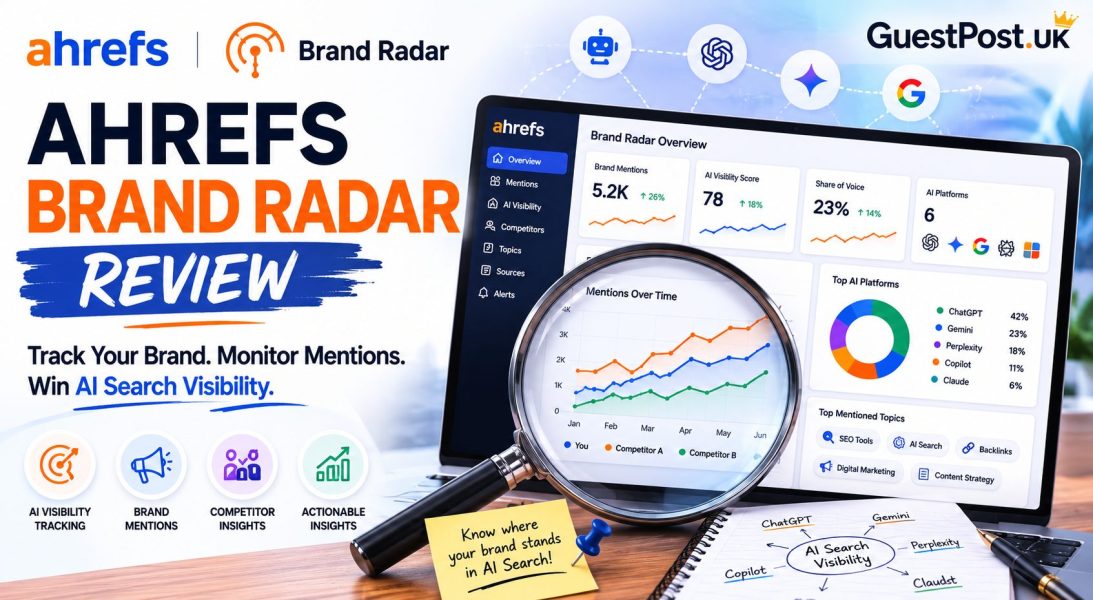
This is where Ahrefs Brand Radar enters the discussion.
What Is Ahrefs Brand Radar?
Brand Radar is Ahrefs’ response to one of the fastest-growing concerns in digital marketing.
The platform helps brands understand how often they are mentioned, referenced, or associated with specific topics and conversations online.
While traditional Ahrefs users are familiar with backlinks, rankings, and keyword research, Brand Radar extends visibility analysis to AI search, brand recognition, and entity tracking.
In simple terms:
Instead of asking:
“How many backlinks do we have?”
Brand Radar encourages marketers to ask:
“How often is our brand becoming part of the conversation?”
Why This Matters More Than Most SEOs Realise
Google’s algorithm has always attempted to understand entities.
Brands.
People.
Products.
Organisations.
Topics.
AI search systems operate in a similar way.
The stronger the association between your brand and a topic, the more likely AI platforms are to recognise you as a relevant recommendation.
Think about HubSpot.
When someone asks about CRM software, HubSpot is likely to appear.
Not only because of rankings.
Because the brand has become closely associated with the CRM topic itself.
Brand Radar helps businesses understand whether those associations exist.
A Surprising Discovery
Returning to the SaaS company I mentioned earlier, we began analysing the visibility gap.
The findings were interesting.
The company had:
- Strong content
- Strong rankings
- Strong backlinks
But very weak brand recognition.
Competitors were repeatedly appearing across:
- Industry publications
- Podcast discussions
- Expert roundups
- Comparison articles
- Community discussions
They were simply being talked about more often.
The lesson was simple.
Visibility isn’t just about ranking.
Visibility is also about recognition.
The Difference Between Rankings and Recognition
One of the biggest misconceptions in SEO is assuming that ranking automatically creates authority.
Sometimes it does.
Sometimes it doesn’t.
Imagine two companies.
Company A ranks for 500 keywords.
Company B ranks for 300 keywords.
Most SEO reports would suggest that Company A is winning.
Now imagine that every major industry publication regularly references Company B.
Suddenly, the situation becomes less obvious.
AI systems often gravitate towards recognised authorities.
This makes brand visibility increasingly important.
What Ahrefs Brand Radar Helps You Understand
Topic Ownership
Brands rarely dominate entire industries.
Instead, they dominate specific topics.
For example:
A cybersecurity company may own:
- Phishing prevention
- Security awareness training
But have little authority around:
- Cloud security
- Zero trust architecture
Brand Radar helps reveal these strengths and weaknesses.
Competitive Brand Presence
Many companies think they know their competitors.
Brand-level analysis often tells a different story.
Sometimes the brands that appear in AI-generated conversations aren’t the same as those in traditional SEO reports.
That difference can create strategic opportunities.
Emerging Trends
One particularly useful feature is trend analysis.
Rather than focusing only on current visibility, marketers can identify:
- Growing brands
- Declining brands
- Emerging topics
- Shifting market conversations
These insights can shape future content strategies.
A Quote Worth Remembering
One marketing director summed up the challenge perfectly during a conference discussion:
“For years we measured who ranked. We’re now learning to measure who gets remembered.”
That may be one of the most accurate descriptions of GEO I’ve heard.
Where Brand Radar Fits Within Modern SEO
Many marketers wonder whether tools like Brand Radar replace traditional SEO platforms.
The answer is no.
In reality, they’re expanding what SEO measurement looks like.
Traditional metrics remain essential.
You still need:
- Technical SEO
- Keyword research
- Link building
- Content optimisation
However, businesses increasingly need visibility beyond search rankings.
Brand Radar helps fill that gap.
The Guest Posting Connection
This is particularly interesting for agencies involved in guest posting and digital PR.
Historically, guest posting campaigns focused on:
- Acquiring backlinks
- Increasing authority
- Improving rankings
Today, those same campaigns may contribute to something else.
Brand recognition.
Every mention, citation, interview, expert contribution, and guest article increases the likelihood that a brand becomes associated with specific topics.
That association may influence future AI-generated recommendations.
This is one reason GEO and digital PR are becoming closely connected.
Lessons Businesses Can Learn From Strong Brands
When analysing companies that consistently appear in AI-generated answers, several common patterns emerge.
They Publish Consistently
Not necessarily more content.
Just more useful content.
They Earn Mentions Beyond Their Own Website
Industry recognition matters.
They Build Topical Depth
They don’t publish random content.
They build expertise around specific subjects.
They Become Sources
AI systems frequently cite brands as trusted sources of information.
The Future of Brand Visibility
If the past decade belonged to keyword rankings, the next decade may belong to entity authority.
The strongest brands will not simply rank.
They will become recognised.
Referenced.
Quoted.
Recommended.
That transition is already underway.
Final Verdict: Is Ahrefs Brand Radar Worth Paying Attention To?
Ahrefs Brand Radar is interesting because it addresses a problem many marketers have only recently begun to notice.
Businesses are beginning to realise that visibility isn’t limited to search engine rankings anymore.
Brand recognition, entity authority, and AI-generated recommendations are becoming measurable marketing assets.
Brand Radar provides a way to monitor that evolution.
For SEO professionals, agencies, SaaS companies, and brands investing in long-term authority building, the platform offers a valuable perspective that traditional ranking reports cannot provide.
The biggest lesson isn’t about the tool itself.
It’s about the shift happening across search.
The companies that understand this shift early will be in a much stronger position as AI-assisted discovery continues to grow.