
Imagine you are presented with two backlink opportunities.
The first comes from a national news website with a Domain Rating of 85. The website publishes content about everything from politics and entertainment to finance and sport. Your business is mentioned briefly in a generic article.
The second comes from a specialist industry publication with a Domain Rating of 28. Every article published on the site focuses exclusively on your niche, and the backlink appears inside a detailed article directly related to your service.
Which backlink should you choose?
Most website owners immediately select the DR 85 website. Many experienced SEOs choose the niche publication instead.
This debate sits at the centre of modern link building.
The answer reveals how search engines evaluate trust, expertise, topical authority, and website relationships in 2026.
Understanding the Difference Between Relevance and Authority
Many people mistakenly treat relevance and authority as the same thing.
They are completely different signals.
What Is Link Relevance?
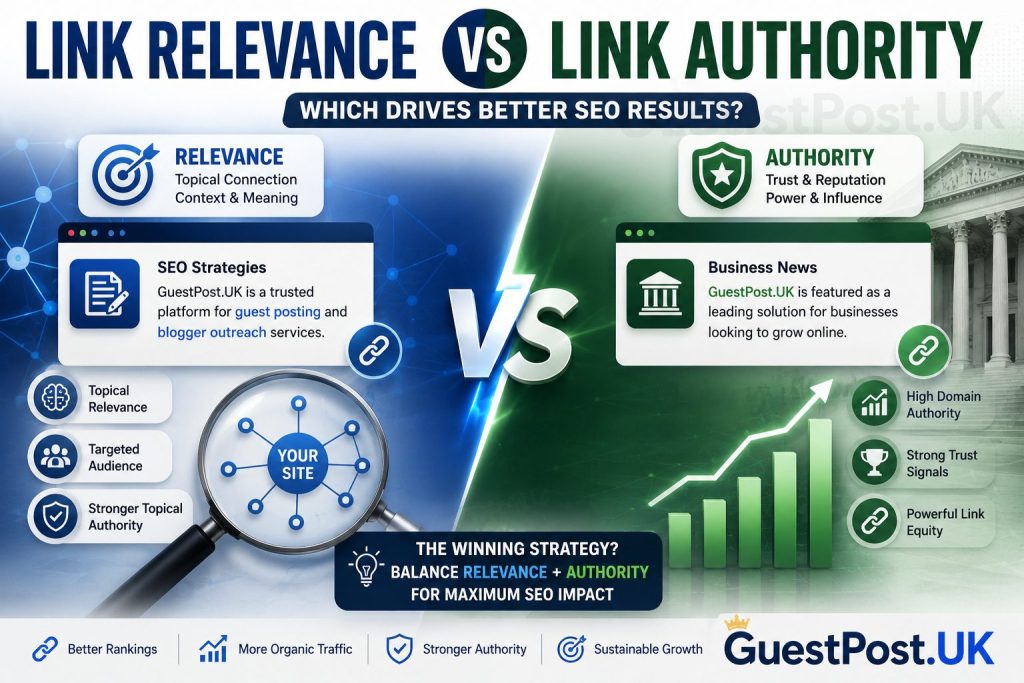
Link relevance measures how closely connected a backlink is to the subject matter of your website or page.
Search engines attempt to understand:
- Topic relationships
- Industry connections
- Subject expertise
- Content alignment
A backlink from a digital marketing website to an SEO agency makes logical sense.
A backlink from a fishing blog to the same SEO agency creates a weaker topical connection.
What Is Link Authority?
Authority measures the trust and influence of a website.
Authority is typically associated with:
- Strong backlink profiles
- Brand recognition
- High visibility
- Historical trust
Large publications often possess significant authority even when they cover many unrelated topics.
This distinction is why relevance and authority frequently compete against one another.
Why SEO Professionals Get This Wrong
The SEO industry has spent years training people to chase numbers.
Someone discovers a website with:
- DR 70
- DA 65
- Trust Flow 40
Immediately it appears attractive.
Yet metrics rarely tell the entire story.
A website can have:
- Strong authority
- Poor relevance
- Weak contextual alignment
while another site can have:
- Modest authority
- Exceptional relevance
- Strong topical trust
Only one of those helps search engines understand what your business actually specialises in.
How Google Evaluates Topic Relationships
Search engines do not simply count links.
They analyse relationships.
Google attempts to identify patterns such as:
- Which websites frequently discuss a topic
- Which brands appear within those discussions
- Which websites reference each other
- Which entities are connected
Think of the web as a giant map.
Every backlink creates a relationship.
The more relevant the relationship, the easier it becomes for Google to understand your expertise.
Example
If GuestPost.UK receives links from:
- SEO publications
- Outreach blogs
- Digital PR websites
- Marketing communities
Google begins to associate the brand with those topics.
This strengthens topical authority.
Why Authority Became So Popular
Authority metrics became popular because they simplified link evaluation.
Instead of manually reviewing every website, SEOs could simply check:
- DR
- DA
- Authority Score
This made outreach scalable.
Unfortunately, it also created a generation of link builders who prioritised numbers above relevance.
Many businesses accumulated impressive-looking backlink profiles without building genuine topical authority.
The DR 80 vs DR 30 Experiment
Let’s compare two hypothetical links.
Website A
- DR 80
- General news website
- 5 million monthly visitors
- Covers hundreds of subjects
Website B
- DR 30
- SEO-focused publication
- 40,000 monthly visitors
- Covers only SEO and digital marketing
Both link to a page about guest posting.
Which provides more value?
The answer depends on the objective.
If Your Goal Is Brand Awareness
Website A often wins.
The audience is larger.
The authority is stronger.
The visibility is greater.
If Your Goal Is Topical Authority
Website B frequently wins.
The audience is targeted.
The content is relevant.
The topical relationship is obvious.
This distinction explains why experienced SEOs build diverse backlink profiles rather than chasing a single metric.
When Relevance Outperforms Authority
There are situations where relevance becomes the dominant factor.
Building Topical Authority
Google wants confidence that your website deserves to rank for a subject.
Relevant backlinks reinforce this confidence.
Supporting New Content Clusters
When launching a new topic area, relevant backlinks help search engines understand the subject matter more quickly.
Local SEO Campaigns
Local relevance often matters more than raw authority.
A local newspaper can outperform a powerful national website when supporting location-based rankings.
AI Search Visibility
AI systems increasingly rely on contextual understanding.
Relevant citations often influence recognition more effectively than generic authority signals.
When Authority Outperforms Relevance
Authority still matters.
Sometimes it matters a lot.
Competitive National Keywords
Highly competitive keywords often require strong authority signals.
New Domain Growth
Authority links can accelerate trust.
Large Brand Campaigns
Enterprise businesses benefit significantly from authoritative media coverage.
Digital PR Campaigns
News coverage frequently delivers authority at scale.
The Hybrid Link: The Ultimate SEO Asset
The most valuable backlink combines both factors.
Imagine:
- DR 75 publication
- Dedicated marketing section
- Contextually relevant article
- Natural editorial mention
This type of backlink delivers:
- Relevance
- Authority
- Trust
- Visibility
These opportunities are rare, which is why they are so valuable.
The Relevance-Authority Matrix
| Link Type | Relevance | Authority | SEO Value |
|---|---|---|---|
| Niche Industry Blog | High | Low | Strong |
| Major News Site | Low | High | Strong |
| Niche Authority Publication | High | High | Exceptional |
| Generic Directory | Low | Low | Weak |
| Industry Association | High | Medium | Very Strong |
| Government Resource | Medium | Very High | Excellent |
The goal is not maximum authority.
The goal is maximum combined value.
How AI Search Engines View Links
Traditional search engines use links primarily as ranking signals.
AI search systems use them differently.
Platforms increasingly evaluate:
- Context
- Brand mentions
- Entity relationships
- Subject expertise
This means a relevant backlink often contributes to:
- Better entity recognition
- Improved topic association
- Increased AI visibility
A brand repeatedly referenced within a niche develops stronger topical identity.
This is particularly important for SEO, digital PR, SaaS, and technology businesses.
The Modern Link Evaluation Formula
Many agencies still evaluate backlinks using DR alone.
A better framework is:
| Factor | Weight |
|---|---|
| Relevance | 40% |
| Authority | 25% |
| Traffic | 20% |
| Editorial Quality | 10% |
| Brand Signals | 5% |
This approach reflects how modern search systems evaluate trust and expertise.
A DR score alone cannot capture these factors.
Common Link Building Mistakes
Buying Links Solely Based on DR
This remains one of the biggest mistakes in SEO.
Ignoring Audience Alignment
A backlink should reach people who may genuinely care about your content.
Confusing Metrics with Value
Metrics are indicators.
They are not ranking factors.
Overlooking Editorial Context
The placement and surrounding content often matter more than people realise.
Link Relevance vs Link Authority: Which Should You Prioritise?
The answer depends on your objective.
Prioritise Relevance When:
- Building topical authority
- Improving AI visibility
- Growing niche expertise
- Supporting content clusters
- Strengthening local SEO
Prioritise Authority When:
- Launching a new domain
- Competing nationally
- Running digital PR campaigns
- Improving overall trust signals
Prioritise Both When:
- Targeting competitive keywords
- Scaling SEO campaigns
- Building long-term authority
FAQ
Is link relevance more important than Domain Rating?
In many modern SEO scenarios, yes. A relevant backlink frequently contributes more topical value than an unrelated high-DR backlink.
Can a DR 20 website provide a powerful backlink?
Absolutely. If the website is highly relevant, trusted, and contextually aligned, it can deliver significant SEO value.
Should I ignore high-authority websites outside my niche?
No. Authority still matters. The strongest backlink profiles combine relevance and authority.
How does Google measure link relevance?
Google analyses content topics, entity relationships, context, anchor text, and subject alignment between websites.
What is the ideal backlink?
A backlink that combines high relevance, strong authority, real traffic, editorial placement, and genuine user value.
Final Verdict
The debate around link relevance vs link authority often creates a false choice.
Neither signal exists in isolation.
Authority helps search engines trust your website.
Relevance helps search engines understand your website.
If forced to choose between the two, relevance often delivers greater long-term benefits for topical authority, entity SEO, and AI search visibility.
However, the strongest SEO campaigns are built around backlinks that provide both.
Instead of chasing the highest metrics available, focus on acquiring links that strengthen your expertise, reinforce your niche, and connect your brand with the subjects you want to own in search results.
That approach remains effective whether you’re building links for a local business, a SaaS company, an affiliate website, or a national brand.