
Two companies enter the same market.
The first invests heavily in backlinks.
Over three years, it acquires thousands of links from directories, guest posts, niche edits, and outreach campaigns.
The second takes a different approach.
It still earns links, but also focuses on becoming visible across its industry through interviews, podcast appearances, expert contributions, guest articles, research studies, industry discussions, and brand mentions.
Fast forward to today.
Both companies rank reasonably well in Google.
Yet when users ask AI platforms for recommendations, the second company appears more frequently.
What happened?
The answer sits at the centre of one of the biggest shifts currently taking place in search.
For years, SEO was largely a game of links.
Today, search engines and AI systems are increasingly evaluating brands as entities rather than simply counting backlinks.
Understanding the difference between Entity SEO and traditional link building may become one of the most important competitive advantages available to businesses over the next decade.
The Era of Counting Links
Much of modern SEO was built on the concept of authority flowing through links.
The logic was straightforward.
If reputable websites linked to your pages, search engines assumed your content deserved visibility.
This approach worked remarkably well.
As a result, entire industries emerged around:
- Guest posting
- Outreach
- Niche edits
- Link exchanges
- Resource pages
- Digital PR
Backlinks became the currency of SEO.
And for a long time, they deserved that status.
The challenge is that links alone rarely tell the full story anymore.
The Shift from Documents to Entities
Traditional search engines primarily evaluated webpages.
Modern search systems increasingly evaluate relationships.
Instead of asking:
Which page deserves to rank?
they are increasingly asking:
Which organisation, brand, person, or company is most strongly associated with this topic?
That change may seem subtle.
In reality, it changes everything.
What Is Entity SEO?
Entity SEO focuses on helping search engines understand who you are, what you do, and which topics your brand should be associated with.
An entity can be:
- A company
- A website
- A product
- A service
- A person
- An organisation
Unlike keywords, entities exist independently.
For example:
“Guest posting services” is a keyword.
“GuestPost.UK” is an entity.
Search systems attempt to understand the relationship between the two.
The stronger that relationship becomes, the easier it is for algorithms to associate the brand with the topic.
The Internet as an Information Network
Most people think of the web as a collection of websites.
Search engines view it differently.
Imagine a giant network.
Every website, brand, author, publication, and topic exists as a node.
Connections are formed through:
- Links
- Mentions
- Citations
- References
- Co-occurrences
The more frequently a brand appears within a specific topic network, the stronger its association becomes.
This is where Entity SEO begins separating itself from traditional link building.
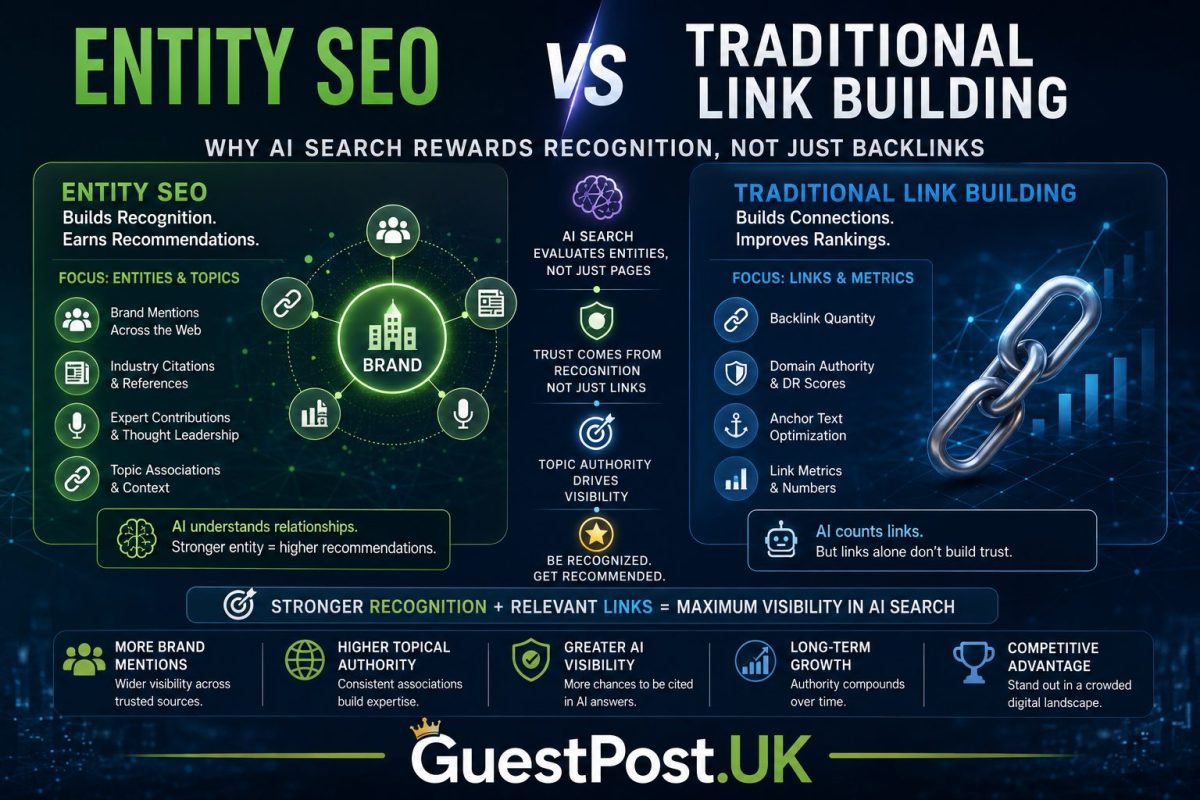
Traditional Link Building Measures Connections
Entity SEO Measures Recognition
This distinction is critical.
Traditional link building asks:
- How many links?
- How strong are the links?
- What is the authority score?
Entity SEO asks:
- How often is the brand mentioned?
- Which topics appear alongside the brand?
- Which trusted sources reference the brand?
- How consistently does the association appear?
One approach focuses on connections.
The other focuses on recognition.
The Three-Layer Authority Model
Most SEO discussions stop at backlinks.
In reality, authority now exists across multiple layers.
Layer 1: Link Authority
This is the traditional model.
Authority passes through links.
Backlinks remain important because they still influence trust and rankings.
Layer 2: Topical Authority
This layer focuses on expertise.
Can search engines confidently identify what your website specialises in?
Topical authority is built through:
- Content clusters
- Relevant backlinks
- Internal linking
- Subject depth
Layer 3: Entity Authority
This layer focuses on recognition.
Can search systems identify your brand as an important participant within a topic?
This is where AI search increasingly operates.
Why Some Brands Outperform Stronger Competitors
One of the most interesting developments in AI search is the emergence of recommendation visibility.
The brands appearing most frequently are not always the brands with the strongest backlink profiles.
Instead, they are often the brands with the strongest entity profiles.
Brand A
- 2,000 backlinks
- Strong DR
- Good rankings
- Limited mentions
Brand B
- 800 backlinks
- Industry citations
- Guest contributions
- Podcast appearances
- Research references
- Expert commentary
When AI systems evaluate authority, Brand B frequently appears stronger.
Not because it has more links.
Because it exists more visibly across the information ecosystem.
Understanding Entity Confidence
Entity confidence describes how certain a search system feels about associating a brand with a topic.
Imagine asking:
Which companies specialise in guest posting?
The AI system looks for confidence signals.
Examples include:
- Industry references
- Guest contributions
- Editorial mentions
- Research citations
- Topic consistency
The more signals available, the higher the confidence level becomes.
Confidence often influences recommendations more than raw backlink volume.
Why AI Search Behaves Differently
Google’s traditional ranking system evaluates webpages.
AI systems attempt to generate answers.
That difference creates entirely new ranking dynamics.
When generating recommendations, AI systems often look for:
- Recognised entities
- Consistent expertise
- Trusted citations
- Topic relationships
A company appearing repeatedly across authoritative discussions becomes easier to recommend.
The Problem with Pure Link Building
Many businesses still follow a simple formula.
Acquire links.
Improve rankings.
Repeat.
The problem is that backlinks alone do not always create recognition.
A website can acquire hundreds of links while remaining largely invisible outside its own domain.
This creates a strange situation.
Strong rankings.
Weak brand authority.
Minimal AI visibility.
The businesses succeeding in AI search are often solving this problem through broader authority-building strategies.
Entity Saturation: A New Competitive Advantage
Consider a topic such as:
- Guest posting
- Cybersecurity
- Digital PR
- CRM software
Some brands appear everywhere.
They show up in:
- Industry blogs
- Interviews
- Research reports
- Podcasts
- Guest articles
- Media coverage
Eventually, they reach a point of entity saturation.
This means the brand becomes difficult to separate from the topic itself.
AI systems notice these patterns.
Why Guest Posting Supports Entity SEO
Guest posting contributes to something larger than backlinks.
Every quality placement expands the number of locations where your expertise exists.
Instead of being limited to your own website, your knowledge becomes distributed throughout the industry.
This strengthens:
- Visibility
- Recognition
- Topic associations
- Authority signals
Over time, repeated exposure reinforces entity development.
The AI Recommendation Test
Try asking different AI platforms:
- Best SEO outreach tools
- Best digital PR platforms
- Best guest posting services
- Best CRM software
Certain brands appear repeatedly.
The reason is rarely backlink volume alone.
Usually, those brands have developed strong entity signals through years of industry visibility.
They have become recognised participants in the conversation.
Traditional SEO Metrics Are Becoming Less Useful
Metrics such as:
- Domain Rating
- Domain Authority
- Trust Flow
remain useful indicators.
However, they struggle to measure:
- Recognition
- Authority within AI systems
- Brand visibility
- Topic ownership
This creates a gap between what SEO tools measure and what AI systems increasingly evaluate.
Building Entity Authority in Practice
The process looks different from traditional link building.
Instead of focusing entirely on links, businesses should aim to increase visibility across multiple channels.
Guest Articles
Contribute expertise externally.
Original Research
Publish data worth citing.
Podcast Appearances
Expand authority signals.
Expert Contributions
Become part of industry discussions.
Digital PR
Generate references beyond backlinks.
Industry Partnerships
Strengthen recognition within niche communities.
Together, these activities create stronger entity signals.
Link Building Is Not Dead
This discussion is not an argument against backlinks.
Backlinks still matter.
The mistake is assuming they are the only signal that matters.
Entity SEO works best when layered on top of strong link acquisition.
Think of backlinks as infrastructure.
Think of entity development as reputation.
Infrastructure without reputation struggles.
Reputation without infrastructure struggles too.
The strongest brands build both.
Where Search Is Heading
Search is moving towards understanding relationships rather than simply ranking pages.
That trend is visible across:
- AI Overviews
- ChatGPT
- Perplexity
- Gemini
- Copilot
The systems generating answers need confidence.
Confidence comes from recognition.
Recognition comes from repeated exposure across trusted sources.
This is why entity development is becoming increasingly important.
FAQ
What is Entity SEO?
Entity SEO focuses on improving how search engines and AI systems understand a brand, organisation, person, or product.
Is Entity SEO replacing link building?
No. Link building remains important, but entity optimisation adds another layer of authority and recognition.
Why do AI systems care about entities?
Entities help AI systems understand relationships, expertise, and authority across large information networks.
Can a brand have strong Entity SEO without many backlinks?
To a degree, yes. Mentions, citations, and industry recognition contribute to entity development even when backlinks are limited.
How does guest posting help Entity SEO?
Guest posting expands visibility across relevant publications and strengthens topic associations around a brand.
Final Thoughts: The Next Battle Is Recognition
For most of SEO history, visibility was largely a function of links.
The next phase of search appears increasingly focused on recognition.
Backlinks still matter.
Authority still matters.
Rankings still matter.
But the brands likely to dominate AI-generated recommendations over the coming years will not simply be the brands with the largest backlink profiles.
They will be the brands whose names appear repeatedly alongside the topics they want to own.
That is the difference between being linked to and being recognised.
And recognition is becoming one of the most valuable assets in search.