
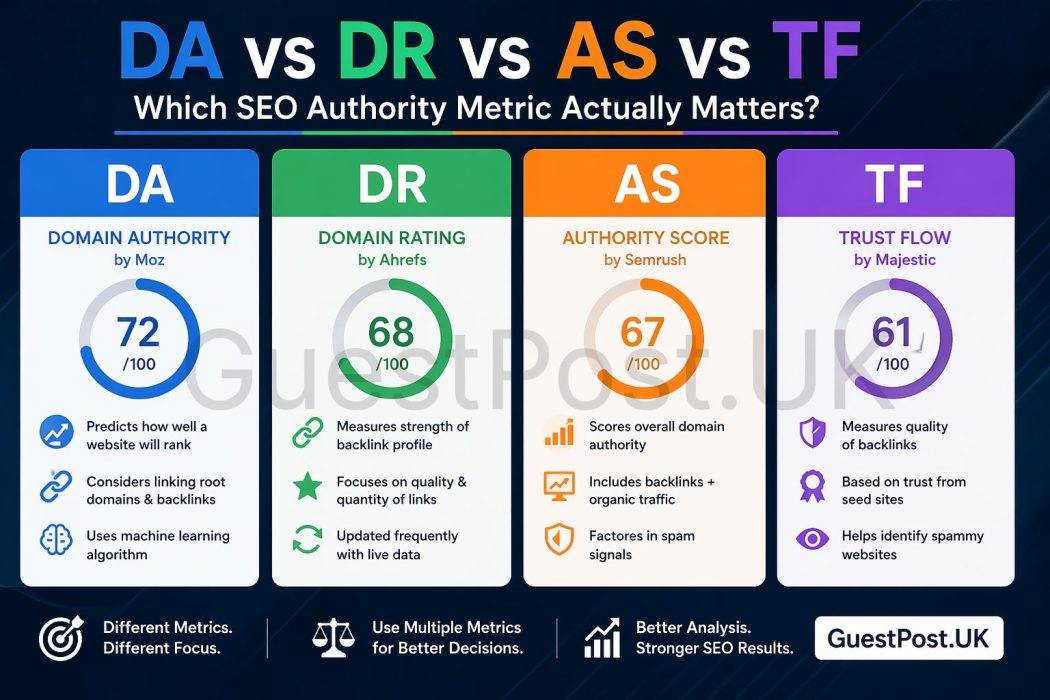
When evaluating websites for backlinks, guest posting, or outreach campaigns, one question always surfaces: which authority metric should you trust? The industry has no shortage of options—Domain Authority (DA) from Moz, Domain Rating (DR) from Ahrefs, Authority Score (AS) from Semrush, and Trust Flow (TF) from Majestic.
Each claims to measure website authority, yet they operate differently, often leading to conflicting signals. A site might have high DA but low TF, or strong DR but mediocre AS. For SEOs, link builders, and guest posting specialists, this inconsistency can be costly if misunderstood.
This guide breaks down DA vs DR vs AS vs TF in depth—how they work, how they differ, and most importantly, how to use them effectively in real-world SEO campaigns.
Understanding SEO Authority Metrics
Before diving into comparisons, it’s important to clarify what these metrics actually represent.
Authority metrics are third-party estimations of a website’s ability to rank in search engines. They are not used directly by Google but are derived from backlink data, link-quality signals, and proprietary algorithms.
Why They Matter in SEO
- Guest posting decisions – choosing high-value sites
- Link building prioritisation – identifying strong domains
- Competitor analysis – benchmarking authority
- Site valuation – assessing digital assets
However, relying on a single metric is a common mistake. Each tool uses different data sources and weighting systems, which is why comparing DA vs DR vs AS vs TF is essential.
What Is Domain Authority (DA)?
Overview
Domain Authority (DA) is a score from 0 to 100 developed by Moz that predicts how likely a website is to rank in search results.
Key Features
- Machine learning-based scoring
- Considers linking root domains and total backlinks
- Logarithmic scale (harder to increase at higher levels)
How DA Works
DA evaluates the overall strength of a domain’s backlink profile. It does not measure traffic or keyword rankings directly but correlates with ranking potential.
Use Cases
- Comparing domains for guest posting
- Evaluating competitors’ authority
- Quick filtering of backlink prospects
Pros
- Widely recognised in the SEO industry
- Easy to interpret
- Useful for quick comparisons
Cons
- Can be manipulated with spammy backlinks
- Slower update frequency
- Less granular than newer metrics
What Is Domain Rating (DR)?
Overview
Domain Rating (DR) is a metric from Ahrefs that measures the strength of a website’s backlink profile on a 0–100 scale.
Key Features
- Focuses heavily on referring domains
- Strong emphasis on link quality
- Updated frequently
How DR Works
DR calculates authority based on:
- Number of referring domains
- Quality of linking sites
- Distribution of link equity
Unlike DA, DR is more link-centric and less influenced by machine learning predictions.
Use Cases
- Link building campaigns
- Prospecting high-quality domains
- Evaluating backlink strength
Pros
- Highly reliable backlink data
- Strong correlation with link power
- Frequently updated
Cons
- Ignores traffic and on-page factors
- Can undervalue niche authority sites
- Requires Ahrefs subscription for full data
What Is Authority Score (AS)?
Overview
Authority Score (AS) is Semrush’s composite metric combining backlinks, traffic, and spam signals.
Key Features
- Multi-factor scoring system
- Includes organic traffic data
- Penalises toxic links
How AS Works
AS evaluates:
- Backlink profile strength
- Organic search traffic
- Spam indicators
This makes it one of the most holistic authority metrics available.
Use Cases
- Vetting guest post sites
- Identifying risky domains
- Evaluating SEO health
Pros
- Balanced metric (links + traffic)
- Spam detection included
- Useful for real-world SEO decisions
Cons
- Less transparent algorithm
- Can fluctuate frequently
- Sometimes inconsistent across niches
What Is Trust Flow (TF)?
Overview
Trust Flow (TF) from Majestic measures the quality of backlinks based on trustworthiness.
Key Features
- Focuses on link quality, not quantity
- Based on a seed set of trusted sites
- Often paired with Citation Flow (CF)
How TF Works
TF evaluates how closely a site is linked to trusted, authoritative websites. A higher TF indicates better link quality.
Use Cases
- Detecting spammy sites
- Evaluating backlink quality
- Filtering guest posting opportunities
Pros
- Strong spam detection capability
- Emphasises trust over volume
- Useful for risk management
Cons
- Smaller link index than competitors
- Less intuitive for beginners
- Needs CF comparison for full context
DA vs DR vs AS vs TF: Core Differences
Feature Comparison
| Metric | Focus | Data Source | Includes Traffic | Spam Detection |
|---|---|---|---|---|
| DA | Ranking potential | Moz index | No | Limited |
| DR | Backlink strength | Ahrefs index | No | Minimal |
| AS | Overall authority | Semrush data | Yes | Yes |
| TF | Link trust | Majestic index | No | Strong |
Performance Comparison in Real SEO Campaigns
Guest Posting
- Best metric: Authority Score (AS)
- Why: Combines authority, traffic, and spam signals
Link Building
- Best metric: Domain Rating (DR)
- Why: Focuses on backlink strength
Spam Detection
- Best metric: Trust Flow (TF)
- Why: Identifies low-quality link networks
Quick Authority Checks
- Best metric: Domain Authority (DA)
- Why: Easy and widely understood
Practical Use Cases for SEO and Guest Posting
Selecting Guest Post Opportunities
A common mistake is choosing sites based solely on DA. Instead:
- Combine DA + TF to avoid spam
- Use DR to assess link equity
- Check AS for traffic validation
Example:
A site with DA 70 but TF 5 is likely spammy.
A site with DR 60 and TF 40 is far more valuable.
Building a Balanced Link Profile
For natural link building:
- Mix high DR and high TF domains
- Avoid over-reliance on one metric
- Prioritise relevance alongside authority
Evaluating Expired Domains
When buying domains:
- Check TF for trust
- Use DR for link strength
- Validate with AS for traffic
Pros and Cons Summary
Domain Authority (DA)
Pros:
- Easy to use
- Industry standard
Cons:
- Can be gamed
- Limited depth
Domain Rating (DR)
Pros:
- Accurate backlink measurement
- Strong for link building
Cons:
- Ignores traffic
- Subscription required
Authority Score (AS)
Pros:
- Holistic metric
- Includes spam detection
Cons:
- Less transparent
- Can fluctuate
Trust Flow (TF)
Pros:
- Excellent for quality assessment
- Detects spam effectively
Cons:
- Limited data index
- Needs context
Graph Insights: How These Metrics Behave
If you were to visualise DA vs DR vs AS vs TF across multiple domains, you’d typically observe:
- DA and DR often correlate but diverge at higher levels
- TF tends to lag behind DA/DR for spam-heavy sites
- AS fluctuates more due to traffic inclusion
This highlights why no single metric is sufficient. Cross-analysis provides the most accurate picture.
DA vs DR vs AS vs TF: Best Use Cases
Use DA When:
- You need quick comparisons
- Working with clients familiar with Moz
- Filtering large domain lists
Use DR When:
- Building backlinks
- Analysing link profiles
- Scaling outreach campaigns
Use AS When:
- Vetting guest post sites
- Avoiding spam
- Evaluating SEO health
Use TF When:
- Checking link quality
- Avoiding PBNs
- Risk management
Final Verdict: Which Metric Should You Trust?
If you’re looking for a single winner in DA vs DR vs AS vs TF, you’ll be disappointed. Each serves a different purpose.
Best Overall Metric
- Authority Score (AS) – most balanced and practical
Best for Link Building
- Domain Rating (DR) – strongest backlink insights
Best for Spam Detection
- Trust Flow (TF) – reliable quality indicator
Best for Simplicity
- Domain Authority (DA) – easy benchmarking
Strategic Recommendation
For professional SEO and guest posting:
- Use at least two metrics together
- Combine DR + TF for link quality
- Add AS for traffic validation
This layered approach significantly reduces risk and improves ROI.
FAQs
What is the most accurate SEO authority metric?
No single metric is universally accurate. Authority Score (AS) is often considered the most balanced because it includes traffic and spam signals alongside backlinks.
Is DA better than DR?
Not necessarily. DA is more general, while DR is more focused on backlinks. For link building, DR is typically more reliable.
Can Trust Flow detect spam websites?
Yes. Trust Flow is specifically designed to evaluate link quality and is highly effective at identifying spammy domains.
Should I use multiple metrics?
Absolutely. Combining DA, DR, AS, and TF provides a far more accurate assessment than relying on any one alone.
Do these metrics affect Google rankings directly?
No. Google does not use DA, DR, AS, or TF. They are third-party estimations designed to help SEOs make better decisions.
Closing Insight
Understanding DA vs DR vs AS vs TF is less about picking a winner and more about building a reliable evaluation framework. The most effective SEOs don’t rely on a single score—they interpret multiple signals, validate with real data, and prioritise relevance above all.
If you’re serious about scaling guest posting or link building, treat these metrics as tools—not truths.