
When you compare Google and Bing, you’re not just looking at two search engines—you’re evaluating two fundamentally different ecosystems that shape how users discover content and how businesses capture traffic.
For SEO professionals, digital marketers, and website owners, understanding the nuances between these platforms is critical. While Google dominates the market, Bing offers unique opportunities that are often overlooked—and sometimes easier to exploit.
In this guide, we’ll break down Google vs Bing across features, SEO factors, traffic potential, and use cases to help you decide where to focus your optimisation efforts.
Compare Google and Bing Search Market Share and User Base
Before diving into features and SEO, it’s essential to understand the scale.
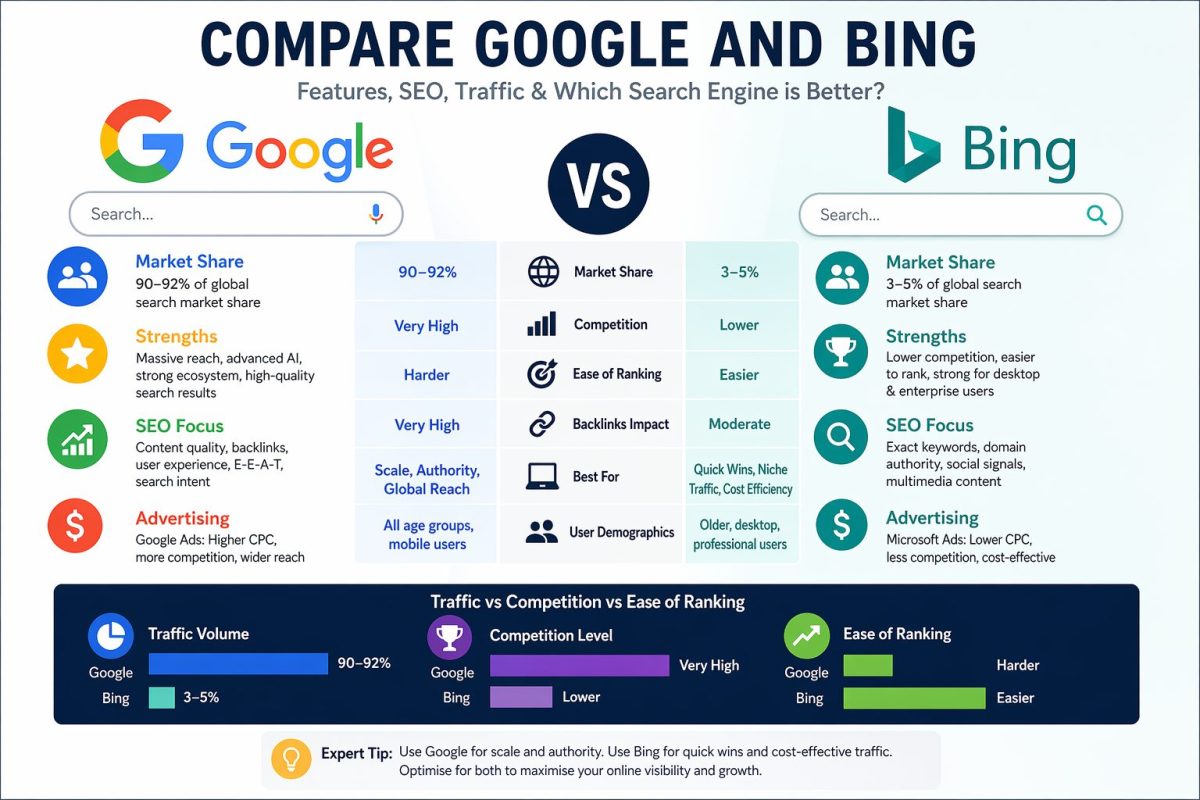
- Google controls approximately 90–92% of the global search market share
- Bing holds around 3–5% globally, but up to 10–15% on desktop in some regions
Key Insights
- Google dominates mobile search
- Bing performs stronger on desktop and enterprise environments
- Bing powers search for platforms like Microsoft Edge, Windows Search, and some AI tools
What This Means for SEO
- Google = volume
- Bing = lower competition + high-value niche traffic
Analogy:
Think of Google as a massive shopping mall packed with customers and fierce competition, while Bing is a boutique high street—fewer visitors, but easier to stand out and convert.
Compare Google and Bing Features and Search Experience
Google Features
- Advanced AI-driven results (Search Generative Experience)
- Featured snippets and People Also Ask
- Google Maps integration
- Google Shopping ecosystem
- Voice search dominance via Android and Google Assistant
Bing Features
- Integrated AI (Copilot-style search responses)
- Strong image and video search
- Visual search capabilities
- Rewards programme (Bing Rewards)
- Better transparency in some search results
Key Differences
- Google prioritises intent and context
- Bing leans more on exact keywords and structured data
Compare Google and Bing SEO Ranking Factors
This is where the real strategic difference lies.
Google Ranking Factors (Simplified)
- Content quality (E-E-A-T)
- Backlinks (authority and relevance)
- User experience (Core Web Vitals)
- Search intent alignment
- Semantic search and AI understanding
Bing Ranking Factors
- Exact keyword usage (still highly relevant)
- Domain age and authority
- Social signals (more influential than Google)
- Multimedia content (images, videos)
- Backlinks (but less complex than Google)
Google vs Bing SEO Comparison Table
| Factor | Bing | |
|---|---|---|
| Algorithm Complexity | अत्य advanced AI-driven | Simpler, more transparent |
| Keyword Matching | Semantic + intent-based | Exact match still important |
| Backlinks | Highly critical | Important but less dominant |
| Social Signals | Minimal impact | Moderate impact |
| Content Quality | Very high priority | Important but less strict |
| Multimedia SEO | Moderate | Strong emphasis |
| Indexing Speed | Fast | Slightly slower |
| Competition Level | Extremely high | Lower |
Compare Google and Bing Traffic Potential
Google Traffic
- Massive reach across all industries
- Higher competition
- More volatile rankings due to algorithm updates
Bing Traffic
- Lower volume but:
- Higher average user age
- More desktop users
- Stronger presence in corporate environments
Conversion Insight
Many marketers report that:
- Bing traffic converts better in certain niches (finance, B2B, SaaS)
- Google traffic drives scale but requires more optimisation
Compare Google and Bing Advertising (Google Ads vs Microsoft Ads)
Google Ads
- Massive reach
- Higher cost-per-click (CPC)
- Advanced targeting and automation
- Strong competition
Microsoft Ads (Bing Ads)
- Lower CPC (often 20–40% cheaper)
- Less competition
- Easier entry for small businesses
- Integration with LinkedIn targeting
When to Choose Each
- Choose Google Ads for scale and visibility
- Choose Microsoft Ads for cost efficiency and niche targeting
Compare Google and Bing for SEO Strategy
When Google is Better
- Content-heavy websites
- Blogs targeting informational queries
- Global audiences
- Mobile-first strategies
When Bing is Better
- Affiliate marketing sites
- Exact keyword targeting
- Older demographic audiences
- Faster ranking for new websites
Pros and Cons of Google vs Bing
Google Pros
- Massive audience reach
- Advanced AI and search intent understanding
- Strong ecosystem (Maps, YouTube, Android)
Google Cons
- Extremely competitive
- Frequent algorithm updates
- Harder for new websites to rank
Bing Pros
- Lower competition
- Easier rankings for new sites
- Better visibility for multimedia content
- Lower ad costs
Bing Cons
- Smaller audience
- Slower innovation historically
- Less refined intent matching
Compare Google and Bing for Guest Posting and SEO Campaigns
For a site doing guest blogging, this comparison is crucial.
Google Strategy
- Focus on:
- High-authority backlinks
- Long-form content
- Topic clusters
- E-E-A-T optimisation
Bing Strategy
- Focus on:
- Exact-match keywords
- Anchor text optimisation
- Social sharing signals
- On-page keyword density
Expert Tip
If you’re building backlinks via guest posting:
- Optimise anchor text for Bing (exact match)
- Optimise contextual relevance for Google
This dual approach allows you to rank effectively on both platforms.
Compare Google and Bing Algorithm Behaviour
- Frequent core updates
- Heavy reliance on AI (RankBrain, BERT, MUM)
- Penalises low-quality content aggressively
Bing
- More stable rankings
- Less frequent major updates
- Easier recovery from ranking drops
Compare Google and Bing Indexing and Crawling
Google Indexing
- Faster crawling
- Prioritises authoritative sites
- Uses Google Search Console for indexing control
Bing Indexing
- Slightly slower
- Easier manual URL submission
- Bing Webmaster Tools provides clear insights
Visual Representation: Traffic vs Competition
Search Engine Landscape (Simplified)

Traffic Volume
Google:  ██████████████████████████████
Bing:    ████

Competition Level
Google:  ██████████████████████████████
Bing:    ███████

Ease of Ranking
Google:  ███
Bing:    ███████████
Advanced Strategies When You Compare Google and Bing
1. Dual Optimisation Strategy
- Write for Google (intent, depth, authority)
- Optimise for Bing (keywords, structure)
2. Exploit Bing’s Weaknesses
- Use exact-match domains or keywords
- Leverage social signals
3. Use Google for Authority Building
- Publish long-form guides
- Build backlinks via guest posting
4. Use Bing for Quick Wins
- Target low-competition keywords
- Rank faster with less effort
Final Verdict: Which is Better—Google or Bing?
If your goal is maximum traffic and brand authority, Google is non-negotiable.
If your goal is faster rankings, lower competition, and cost efficiency, Bing offers a compelling advantage.
Best Approach
The smartest strategy isn’t choosing one—it’s leveraging both:
- Use Google for scale and credibility
- Use Bing for efficiency and untapped traffic
Businesses that ignore Bing are leaving easy rankings and conversions on the table.
Frequently Asked Questions About Comparing Google and Bing
Is Bing better than Google for SEO?
Bing is easier to rank on, especially for new websites, but Google offers significantly more traffic.
Why does Google dominate search?
Google’s advanced algorithms, AI capabilities, and ecosystem integration make it the preferred search engine globally.
Can you rank faster on Bing?
Yes. Bing typically has lower competition and rewards exact keyword optimisation, making rankings easier to achieve.
Is Bing traffic valuable?
Absolutely. Bing users often have higher purchasing intent, especially in B2B and finance niches.
Should I optimise for both Google and Bing?
Yes. A dual optimisation strategy ensures you maximise visibility, traffic, and conversions.
Strategic Takeaway for SEO Professionals
When you compare Google and Bing, the conclusion is clear:
- Google is essential for long-term dominance
- Bing is a strategic shortcut for quick wins
If you’re running SEO campaigns or guest posting strategies, integrating both platforms into your workflow will give you a measurable competitive edge.